The instrument beneath the missing observatory
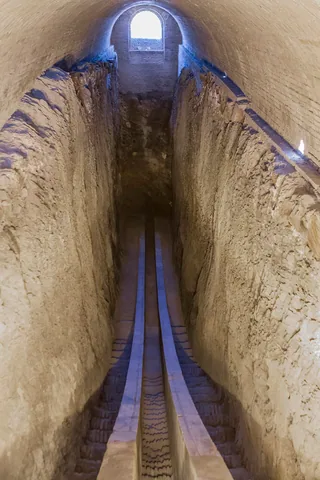
At Ulugh Beg Observatory in Samarkand, Uzbekistan, the most revealing remains descend into the ground. Two curved stone tracks survive from a giant instrument used to measure the height of celestial bodies as they crossed the local meridian. The full observatory rose above them in the fifteenth century, before telescopes existed.
Ulugh Beg was Timur's grandson, a ruler who supported a community of mathematicians and astronomers. Their work produced astronomical tables and a star catalogue. The instrument is often called a sextant, although descriptions also use quadrant; it is safest to understand its job as precise measurement of angles. Look at the scale of the surviving curve and imagine how far it continued above you. A building and an instrument were designed together.
What the curved tracks measured
The observatory's large instrument lay in a north to south plane. Astronomers could use it to measure the altitude of the Sun and other bright celestial bodies at meridian passage. You do not need a telescope to measure an angle. You need an accurately arranged instrument, a reliable scale and careful observation.
The curve was exceptionally large, with a radius of about forty metres. Increasing the physical size of a scale makes small differences easier to distinguish. Think of reading a fraction of a degree on a school protractor, then of spreading that scale across a substantial part of a building.
Only the lower portion survives. A reconstruction drawing can help you grasp the missing height, but it remains a reconstruction. The trench and tracks are the material evidence; the vanished building has to be recovered through excavation and written descriptions.
A ruler among working astronomers
Ulugh Beg's name dominates the site, but astronomical work depended on more people than its patron. Qazizadeh Rumi and Ali Qushji belonged to the scholarly community associated with Samarkand. Training, calculation and repeated observations made the tables possible.
His madrasah at the Registan formed another part of that environment. The connection is useful if you have already seen the square: a royal school in the city and a purpose-built observatory outside its older centre supported related intellectual work.
Astronomy also had practical and courtly uses, including calendars and the interpretation of celestial signs. The boundary between astronomy and astrology did not match the one used today. That does not diminish the seriousness of the measurements. It helps explain why a ruler would pay for them.
A catalogue that could travel
The star catalogue associated with Ulugh Beg lists more than a thousand stars. A catalogue records positions so that other observers can compare, calculate and check. It can survive the building where its measurements were made.
Modern researchers have compared Ulugh Beg's catalogue with modern star data. They measured the errors in its recorded positions, finding fewer very large errors than in Ptolemy's much older catalogue. The results give a precise way to judge the achievement of observers working without telescopes.
Manuscripts and later printed editions carried the work beyond Samarkand. The observatory disappeared, while the tables continued to circulate. That is the distinction to remember when looking at these incomplete remains: knowledge could leave the site in a form that did not need its enormous apparatus to travel.
Finding a vanished building
Archaeologist Vasily Vyatkin identified the observatory's remains in 1908. Later excavations helped clarify the plan. The surviving instrument and the museum belong to a place recovered through archaeological work, rather than an intact medieval observatory still awaiting its next night of observations.
Before leaving, look again at the descending curve. It is easy to remember the size and miss the precision. The builders made something this large so that the astronomers could work with very small differences.
 🇺🇿
🇺🇿 🕌
🕌 🕌
🕌 🕌
🕌 🔭
🔭 🏺
🏺 🕌
🕌 🕌
🕌 🧺
🧺 🕌
🕌