The shrine at the end of the passage
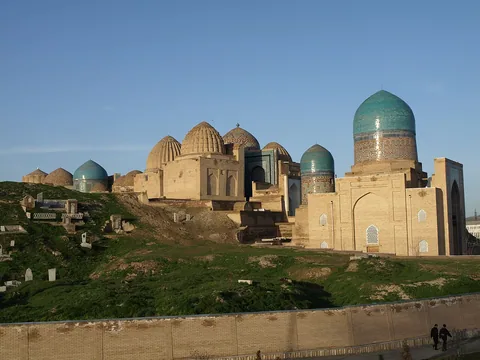
Shah-i Zinda in Samarkand, Uzbekistan, is a sequence of mausoleums and religious buildings arranged along a passage. Its name means "Living King" and refers to Qutham ibn Abbas, a cousin of the Prophet Muhammad whose shrine is the religious focus of the ensemble. The story that he escaped death and lives beneath the ground is a local sacred legend.
You meet one decorated doorway after another, often close enough to compare their surfaces directly. The ensemble grew over centuries around a revered place. Begin with a single doorway: notice how a border surrounds the entrance, then compare it with its neighbour. This is a burial place and a place of devotion as well as an architectural encounter.
Why the buildings follow a passage
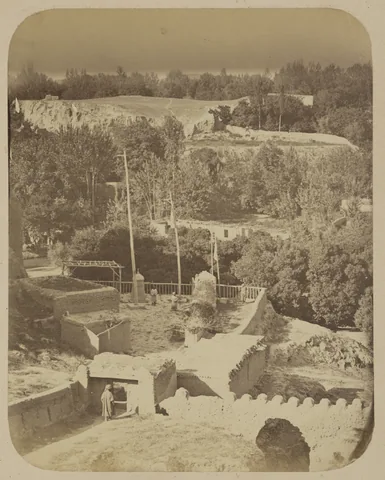
The ensemble occupies the edge of Afrasiab, the ancient city of Samarkand. Its buildings follow an old street through what was once a residential quarter. That earlier urban setting helps explain the experience of moving along a shared passage.
Each mausoleum presents a front to that space. A doorway has its own border and decorated arch, yet it also belongs to a sequence leading towards the shrine. If you only examine part of the ensemble, keep that larger arrangement in mind. A close view of one wall and a longer view along the passage answer different questions about the place.
The women behind the decorated doorways
Several mausoleums commemorate women in Timur's family. Shadi Mulk Aqa was his niece; her mother Turkan Aqa commissioned her tomb in the 1370s. Shirin Biqa Aqa was Timur's sister.
At Shadi Mulk's tomb, carved glazed terracotta gives the decoration depth. Compare how a letter or stem projects from its background and holds shadow. The relief is part of the ceramic work, not just an effect of its colour.
Domes collapsed and restorers renewed parts of the buildings. Surviving decoration and replacement work coexist here, so a bright surface alone cannot tell you its age.
Leave room for the shrine
The passage carries people coming for religious reasons. Give others space at entrances, and follow the instructions at each chamber.
You can leave with one close comparison in mind: how two neighbouring entrances frame their openings. Read the individual wall, then the shared passage, without needing to turn every building into a separate stop.
 🇺🇿
🇺🇿 🕌
🕌 🕌
🕌 🕌
🕌 🔭
🔭 🏺
🏺 🕌
🕌 🕌
🕌 🧺
🧺 🕌
🕌