A painted room from the earlier city
Afrasiab Museum in Samarkand, Uzbekistan, explains the ancient city whose remains occupy the ground around it. This is the place to look beyond the Timurid monuments towards earlier Samarkand, including its Sogdian history. Wall paintings occupy the museum's central room, while pottery and other excavated objects give the city a more ordinary, domestic scale.
Look at clothing and gestures in the paintings before moving to the smaller objects. The museum and the site work best together: decorated rooms and useful vessels help populate a city that no longer has its streets and houses standing intact. Outside, the archaeological ground gives those fragments a physical setting.
An earlier city beside the later one
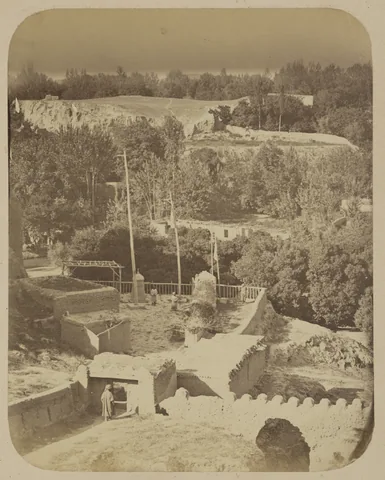
Afrasiab is the archaeological site of Samarkand before the Mongol conquest. Its remains lie north of the main Timurid monuments. Ancient and later Samarkand occupy neighbouring areas, so a journey through the city's history is also a movement across its ground.
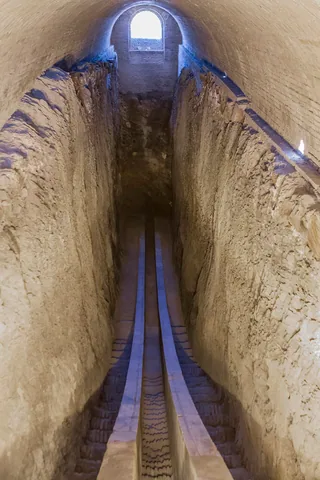
Excavation has revealed residences, religious buildings and water infrastructure. These categories matter because a city needed more than a royal centre. It needed somewhere to make things, bring in water and accommodate people who had no place in a ruler's official story.
The museum's collections include pottery, glass, metal and architectural fragments. A painted wall may hold your attention longer, but an ordinary vessel can answer a different question: what someone made or used while living here. Leave some time for those smaller survivals.
Who are the visitors on the wall?
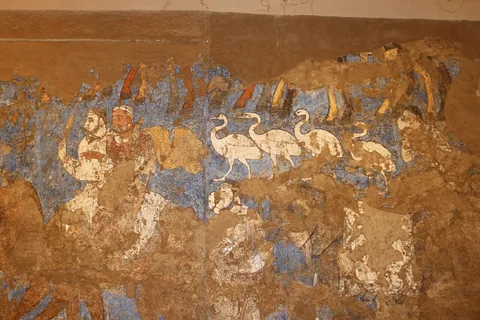
The seventh-century murals include foreigners carrying gifts, which gave the room its conventional name, Hall of the Ambassadors. An inscription names Samarkand's ruler Varkhuman. The central figure is lost, and both scene and room remain debated.
Road construction exposed the murals in 1965 and destroyed parts of them. Conservators moved and restored surviving paintings. Imagine their borders meeting at corners: they decorated a surrounding room.
Read the objects back into the ground
Samarkand's history museum opened here in 1970. Its remit extends beyond the painted room, tracing the city over many centuries before the thirteenth-century destruction. That longer span prevents the murals from becoming the whole history of Afrasiab.
If you look out across the site after the galleries, resist the temptation to supply complete palaces wherever the ground rises. Archaeology depends on differences in walls, deposits and finds that are not all legible to a passing visitor. The museum gives you enough to begin more modestly: people lived here, made vessels, moved water and decorated rooms. The fragments are small because the city was large and its survival uneven.
 🇺🇿
🇺🇿 🕌
🕌 🕌
🕌 🕌
🕌 🔭
🔭 🏺
🏺 🕌
🕌 🕌
🕌 🧺
🧺 🕌
🕌