Begin with a loaf of Samarkand bread
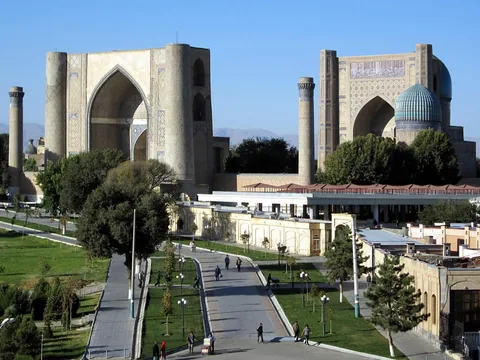
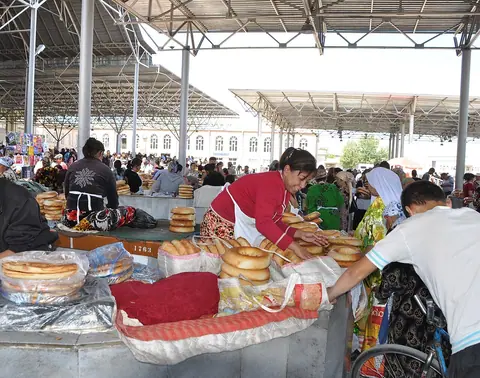
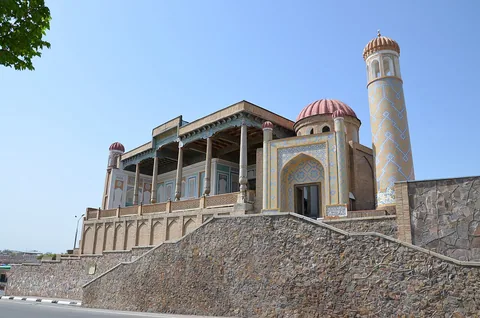
Siyob Bazaar in Samarkand, Uzbekistan, is the food market beside Bibi-Khanym Mosque. Its name also appears as Siab. The mosque draws attention upward to monumental architecture; the market brings your eye back to goods that people buy, carry and eat. Dried fruit, nuts and sweets are among the products identified here by the national tourism authority, along with Samarkand bread.
Use the bread as a starting point. Uzbek non is baked against the hot wall of a clay oven called a tandir or tandoor. You need not see an oven at the market to recognise that the loaf is the result of a particular way of baking. Look at what is on sale, leave room for trading, and ask before photographing a seller. This is a working market, so the details change with the day and the season.
A market alongside a monument
The proximity to Bibi-Khanym makes this a useful pair of places to understand together. One involved the concentrated resources of a ruler; the other concerns repeated exchanges among many people. A purchase may be small, but there are many of them.
The regional administration lists Siyob as a dehqon market, a category associated with agricultural produce. Official statistics staff have also used the market for price observations. That is an unusually practical reminder of what a bazaar does: it is somewhere to measure the cost of food as well as somewhere to admire a display.
You do not need to turn a visit into an inventory. Choose a category of goods and notice how sellers divide it by variety, size or preparation. A pile that first seems uniform often becomes much more specific once you ask what the differences are.
What makes a tandir loaf?
The national tourism authority describes vertical tandirs in the Samarkand region. The oven is heated before the baker attaches dough to its inner wall. The bread cooks against a hot surface inside an enclosed chamber, rather than lying on a shelf in a familiar domestic oven.
This explains why a loaf can invite two different kinds of attention. Its visible face has a designed surface, while the other side met the oven wall. If you buy one, compare those faces before breaking it. The method is easier to understand when you have the finished object in your hands.
Bread is also something people take when visiting another city. A loaf can therefore be both food for the table and something carried home from Samarkand. That is a more useful starting point than treating every item in the market as a souvenir made for visitors.
The emir who could not reproduce the bread
A local legend tells of an emir of Bukhara who wanted Samarkand bread made in his own city. Bringing the flour did not work. Neither did the water, the oven material or even the baker. He had to go on obtaining the bread from Samarkand.
The tale expresses pride in a local food. It is not evidence that the bread can be made only in one place, and stories of extraordinary keeping qualities should not be taken as storage advice. You can enjoy the story while judging the loaf in front of you on ordinary terms.
Let that distinction guide the rest of the visit. Names and traditions give food a history; the market also asks straightforward questions about quantity, quality and price. If you decide to buy, establish what is being weighed and what the quoted price covers. A clear, unhurried exchange will tell you more about the market than a quick photograph of its entrance.
 🇺🇿
🇺🇿 🕌
🕌 🕌
🕌 🕌
🕌 🔭
🔭 🏺
🏺 🕌
🕌 🕌
🕌 🧺
🧺 🕌
🕌