An old sacred place with later buildings
Hazrat Khizr Mosque in Samarkand, Uzbekistan, stands at the southern edge of Afrasiab, near the meeting of the streets leading towards Shah-i Zinda and the old centre. Its name recalls Khizr, the sacred figure associated with travellers and the water of life. The mosque belongs to a place with old religious traditions, although the surviving building includes much later work.
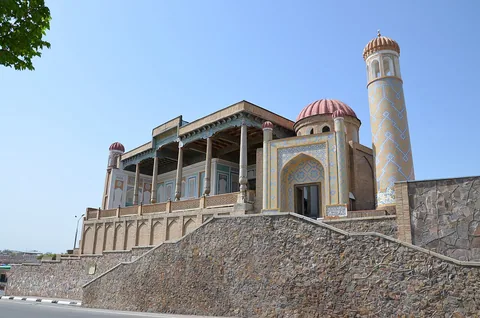
Look at the veranda and its roof supports before grouping it with Samarkand's great Timurid monuments. The regional heritage account records rebuilding of the veranda and gateway in 1899, with further work in the early twentieth century. The complex also contains the mausoleum of Uzbekistan's first president, Islam Karimov, who was buried here in 2016. The mosque and that modern memorial have different histories, even though they share a setting.
Why the site matters before the dates
At Afrasiab's southern edge, the mosque occupies a meeting point between the ancient settlement and the later city. That position helps explain why an old religious reputation could persist through successive rebuilding.
Local accounts connect the place with Samarkand's earliest Muslim worship and with an earlier sanctuary on the hill. The surviving architecture cannot by itself verify every stage of that story. The building before you is better understood through its documented repairs and additions than through an unbroken claim to an eighth-century structure.
The distinction is useful throughout Samarkand. A place may be old even when much of the building is later. A sacred name can remain while walls and roofs change around it.
Khizr and the water of life
The heritage directorate identifies Khizr as a protector of travellers and a figure linked to the legendary water of life. These associations give the mosque's name a meaning that extends beyond a personal dedication.
You do not need to treat the legend as a literal event to understand why it suited a place visited by travellers. Water and safe passage are readily understood concerns. The name brings those hopes into the religious explanation of the site.
The regional account also records the cleaning and recovery of the nearby Arzis well during restoration. That is a physical feature connected with the place's water traditions. It does not establish the legendary properties of any water associated with it.
Reading a building that kept changing
The mosque's veranda gives you a different architectural scale from the enormous portals at the Registan or Bibi-Khanym. Here, roof and supports make a sheltered edge where the relationship between the open air and an enclosed room is easy to follow.
Work on the veranda and gateway in 1899 preceded later rebuilding of the gateway and minaret in the early twentieth century. Repairs continued after Uzbekistan became independent, and the mosque was restored again during construction of the presidential memorial.
Look at the parts individually: a roofed open space, an entrance structure, a minaret. They do different jobs and need not have acquired their present forms at the same moment.
The president's mausoleum is a separate chapter
Islam Karimov was buried in the mosque complex on 3 September 2016. A purpose-built memorial opened in January 2018. Those dates place it firmly in the history of independent Uzbekistan.
The official opening account describes craftspeople from across the country contributing to the memorial. Its presence changes the historical range of a visit: a mosque with old sacred associations now neighbours a state commemoration of a modern political leader.
Keep each part legible. Khizr explains the mosque's dedication; Karimov's mausoleum explains a later commemorative decision. Follow local instructions around both places and leave space for people who have come to pay their respects.
 🇺🇿
🇺🇿 🕌
🕌 🕌
🕌 🕌
🕌 🔭
🔭 🏺
🏺 🕌
🕌 🕌
🕌 🧺
🧺 🕌
🕌