A grandson's tomb becomes the ruler's resting place
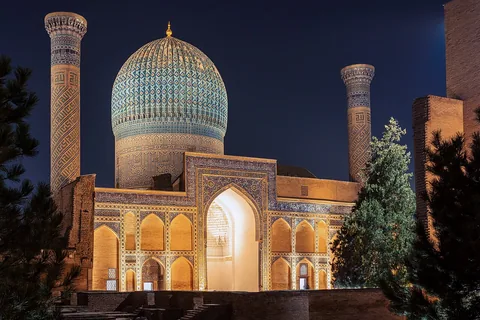
Gur-e Amir in Samarkand, Uzbekistan, is the burial place of Amir Timur, also called Tamerlane. Its story began with his grandson Muhammad Sultan, who established an educational complex here and died in 1403. Timur's own death in 1405 brought the ruler into a place already shaped by a family loss. Later work turned it into a dynastic mausoleum.
Outside, look at the ribbed blue dome and the many-sided building beneath it. If you enter the burial chamber, the dark green jade marker identifies Timur's commemorative position among the other tomb markers. These are cenotaphs: the burials lie in a crypt below. The distinction matters. The room presents a family and its remembered authority, while the actual graves occupy a different level.
Muhammad Sultan came first
Timur's name can make it easy to overlook the young man for whom the mausoleum developed. Muhammad Sultan was his grandson and intended heir. The complex began with a madrasah, and his unexpected death during the final years of Timur's reign changed its purpose.
Timur ordered a mausoleum for him. When Timur died while setting out on his campaign against China, his body returned to Samarkand and joined his grandson's. The ruler had commanded a huge empire, yet the sequence here begins with a plan for a descendant who did not outlive him.
The complex continued to change under Ulugh Beg, another of Timur's grandsons, during the reign of Timur's son Shah Rukh. The family relationships can become confusing. What matters in front of this building is that several generations helped make it a place through which the dynasty could remember itself.
Why the dome looks different from the room
The mausoleum has an octagonal exterior and a dome with pronounced vertical ribs. Follow one rib with your eye from the lower curve towards the top. Repetition makes the surface legible at a distance, while the ceramic colour separates it from the earth-coloured masonry beneath.
The bulbous dome rests above a band of muqarnas, the stepped forms often compared with stalactites. Notice the changes of shape: a many-sided base, a rising support, then the swelling curve overhead. The transitions let a relatively compact building carry a conspicuous crown.
Its present setting does not show the educational complex exactly as Muhammad Sultan knew it. Thinking of it as a surviving part of a larger ensemble helps explain why the mausoleum's story includes buildings that have disappeared.
The jade marker is above the grave
In the upper chamber, the dark stone is a cenotaph, placed above Timur's burial in the basement crypt. Ulugh Beg installed it after his grandfather's death. The stone makes the ruler's place identifiable within the shared room.
Jade had value beyond its appearance in Timurid court culture. A surviving cup owned by Ulugh Beg, now in the British Museum, belongs to the same world of prized stone objects. People associated jade with protective powers, including protection from poison. Those beliefs help explain its appeal without making them true physical properties of the material.
If you can see the chamber, let your eye move between the dark marker and the decorated surfaces around it. The stone's restraint gives it a different presence from the room's gold and colour. It is a small object compared with the building, but it directs attention very effectively.
A restored room and a remembered ruler
The mausoleum has undergone substantial restoration, including renewed gilding and rebuilt minarets. Its apparent completeness should not be read as untouched survival. The building has a fifteenth-century history and a history of later care and reconstruction.
If you can see the chamber, take a final look at the markers as a group. Muhammad Sultan, Timur and later relatives share a space whose purpose changed as the family lost successive generations. The ruler occupies the most recognisable position, but the place began with his grandson.
 🇺🇿
🇺🇿 🕌
🕌 🕌
🕌 🕌
🕌 🔭
🔭 🏺
🏺 🕌
🕌 🕌
🕌 🧺
🧺 🕌
🕌