A mosque built on an imperial scale
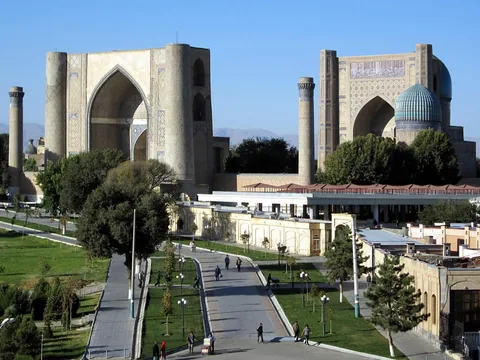
Bibi-Khanym Mosque in Samarkand, Uzbekistan, was Timur's great congregational mosque, built from 1399 during the final years of his rule. It takes its familiar name from his senior wife, Saray Mulk Khanum. Stories that she secretly built it for him belong to legend; the documented commission was Timur's.
Look first at the relationship between the enormous entrance and the domed sanctuary across the courtyard. Their scale was meant to make an impression before anyone examined a tile. The building also suffered early structural problems and centuries of damage. Substantial restoration has recovered its outline, so the present mosque combines surviving fabric with modern reconstruction. The stone Qur'an stand in the courtyard offers a smaller, though still unusually large, object through which to understand the same ambition.
A ruler who wanted a larger entrance
Timur began the mosque after his campaign in India. The building drew on Iranian mosque design and on the labour and skill assembled through his empire. Its construction belonged to a political world in which an imperial capital had to demonstrate the resources of its ruler.
The Spanish envoy Ruy González de Clavijo reached Samarkand while the work was under way. He described Timur demanding a rebuilt entrance because the existing one was too low, then coming to supervise labour even as his health failed. Clavijo's account is an outsider's record, but it puts a person and a decision behind the intimidating proportions.
You can read the entrance with that episode in mind. The arch frames a great volume of empty space, while the human doorway occupies only a small part of the composition. Height was part of the message.
A courtyard with four architectural directions
The mosque follows a courtyard plan with four iwans, or large vaulted openings. The main sanctuary occupies the side opposite the entrance, with smaller domed spaces on the flanks. This arrangement gives the courtyard a clear set of axes.
Try to distinguish the arch that presents a building from the dome behind it. They solve different problems. The arch makes a large public front; the dome covers the space where people gathered. In Timurid construction, separate inner and outer dome shells could give the exterior a dramatic height without imposing exactly the same shape on the room beneath.
Much of the original enclosure has been lost. The open areas should therefore prompt a little caution when imagining the historic mosque filled with worshippers. Today's outline helps make the scale intelligible, but it does not recreate every colonnade and small dome of the earlier building.
The stone bookstand
The large Qur'an stand in the courtyard is associated with Ulugh Beg, Timur's grandson. It was originally placed in the sanctuary and later moved outside. Its size makes sense beside the mosque's immense architecture: even a furnishing could take on a monumental scale.
There is an important difference between a bookstand and a book. The object does not establish that one particular surviving manuscript was used on it. It shows that supporting and presenting a manuscript could itself become a substantial act of patronage.
Compare its scale with an ordinary reading stand you might know. That comparison brings the building's imperial dimensions closer to something practical: a reader, a book, and the stone intended to carry it.
What the rebuilt skyline can tell you
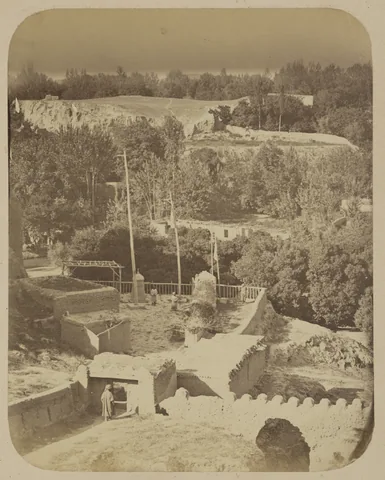
The mosque's great size and the speed of construction contributed to its structural difficulties. By the time early photographs recorded it, much had collapsed. Photographs from repeated visits in the later twentieth century document major changes as domes and fronts were restored.
That record gives you two ways of looking. You can appreciate the recovered spatial composition and still ask which surfaces and structures survived from Timur's period. Both questions belong here.
The mosque's name, the ruler's demands and the later repairs can pull the story in different directions. The visible link is the problem of scale: how to build something exceptionally large, keep it standing, and decide what to restore after it falls.
 🇺🇿
🇺🇿 🕌
🕌 🕌
🕌 🕌
🕌 🔭
🔭 🏺
🏺 🕌
🕌 🕌
🕌 🧺
🧺 🕌
🕌