Two patrons face each other across the street
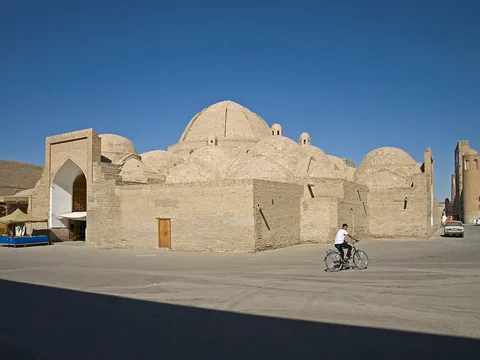
The madrasas of Ulugh Beg and Abdulaziz Khan face one another near the jewellers' dome in Bukhara, Uzbekistan. They look like a pair because of their position, but more than two centuries separate them. Ulugh Beg's school was built in 1417; Abdulaziz Khan's followed in 1652.
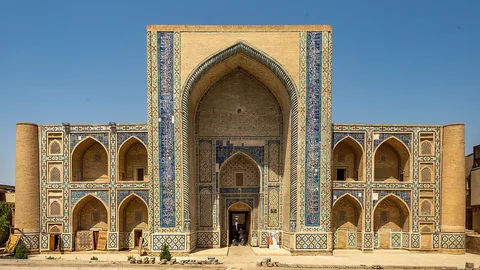
Use the street between them as a place to compare. Both buildings announce a place of learning with a monumental entrance. Abdulaziz Khan's entrance gives ornament far more room, with a deep decorated arch and a more elaborate treatment of its surfaces.
The older building carries an association with Ulugh Beg's patronage of learning, while the later one shows how another ruler chose to build opposite an established institution. The pair lets you see continuity without assuming that Bukhara's architecture stayed the same. Each patron used a familiar building type to make a new commission recognisable as his own.
What the older doorway says about learning
Ulugh Beg commissioned madrasas in Bukhara, Samarkand and Gijduvan. The Bukhara building is associated with the builder Ismail, son of Tahir, whose family origin is given as Isfahan.
Its doorway bore an inscription stating that seeking knowledge was a duty for Muslim men and women. That is a claim about the value of learning. It does not, on its own, establish who was admitted to study in the building.
The museum's account describes theology, astronomy, philosophy and mathematics among the subjects taught here. A madrasa was an educational institution with rooms and teaching spaces, even when its entrance now attracts more attention than the work once done behind it.
The later entrance makes room for creatures
The Abdulaziz Khan Madrasa is particularly rich in ornament. Among its decorative subjects are a dragon and the fabulous bird known as the simurgh. The museum identifies both on the portal.
Try looking for a recognisable creature within the larger pattern, then step back to see how it fits the arch. This is different from reading a single emblem on a blank wall. The figure belongs to a dense arrangement of colour and plant forms.
The dragon and simurgh belong to the decorative subjects used on this seventeenth-century school. They are part of its public facade, visible among the other ornament.
A carved door brings the scale down
The Abdulaziz Khan building is also associated with the museum's collection of woodcarving. Its holdings include doors, shutters and carved pearwood blocks used for printing cloth. If those galleries are accessible, they offer a change from the scale of a ruler's portal to the work of a hand tool.
The Ulugh Beg building has housed a display on Bukhara's calligraphy. Together, those museum uses invite attention to writing and craft as well as rulers and dates.
From the street, the two entrances remain visible together. You can compare their proportions without entering either building.
 🇺🇿
🇺🇿 🏰
🏰 🧱
🧱 💧
💧 🌳
🌳 🛍️
🛍️ 📚
📚 🏛️
🏛️ 🦁
🦁 🏠
🏠