A private house with a public history
The house museum associated with Fayzulla Khodjaev is in Bukhara, Uzbekistan. It belonged to his father, Ubaydullo Khoja Kasym Khodjaev, a wealthy merchant whose trade reached Russia and Germany. The decorated domestic rooms show the family's wealth before the political career of the son takes the story elsewhere.
Fayzulla Khodjaev joined the reform movement known as Jadidism and became a leading figure in the government that replaced the emirate. He later headed the government of Soviet Uzbekistan. Arrested in 1937, he was executed in 1938.
The house brings those two histories into the same visit. A painted room can introduce merchant life; a document or photograph can lead into the upheavals of the twentieth century. The house was a family possession before it became the setting for a museum about a political leader.
Wealth arranged around domestic life
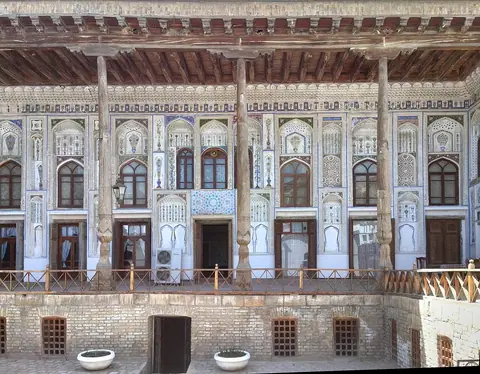
The complex contained household service areas, a men's section and a women's section. Guest rooms, summer rooms and winter rooms gave domestic life more specialised spaces than the phrase private house might suggest.
The carved and painted woodwork, together with decorated plaster surfaces, rewards close attention. A room's ornament can be admired as a pattern, but its position also matters. A formal room for receiving guests did a different job from a service space.
The museum has restored period interiors. Treat those displays as an interpretation of late nineteenth- and early twentieth-century life, rather than assuming that every object has remained untouched in exactly the same place since the family lived here. The building and the furnishing of a museum are connected, but they are not the same historical evidence.
From reform to government
Khodjaev was born in 1896 and joined the Jadid movement as a young man. He also participated in the Young Bukharan movement.
He headed the Bukhara People's Soviet Republic from 1920 to 1924, then the government of the Uzbek Soviet Socialist Republic from 1925 to 1937. These roles place him on the governing side of the transformation, not simply among those who watched it happen.
The domestic setting makes that transition unusually tangible. The son of a prosperous trading family helped replace the political order under which the family's wealth had been made. That does not make the rooms a simple illustration of his later beliefs. They describe the background from which he came.
The documents that survived repression
The museum's account emphasises how few of Khodjaev's documents and personal materials survived repression. He was arrested in 1937 and shot in Moscow the following year. His rehabilitation came in 1965.
The later rehabilitation belongs to the story of how a condemned official could come to be publicly commemorated.
His museum shares the building with displays of merchant life. The combination leaves a useful tension. The furnished rooms can appear settled and secure; the political biography describes how rapidly a person's position could collapse. A surviving house can preserve the setting of a life while only fragments of its paperwork remain.
 🇺🇿
🇺🇿 🏰
🏰 🧱
🧱 💧
💧 🌳
🌳 🛍️
🛍️ 📚
📚 🏛️
🏛️ 🦁
🦁 🏠
🏠