A different Bukhara beyond the old city
Sitorai Mokhi Khosa, north of Bukhara in Uzbekistan, was the country residence of the city's last emirs. Its early twentieth-century rooms bring local decorative work together with furnishings and architectural ideas from Russia and Europe.
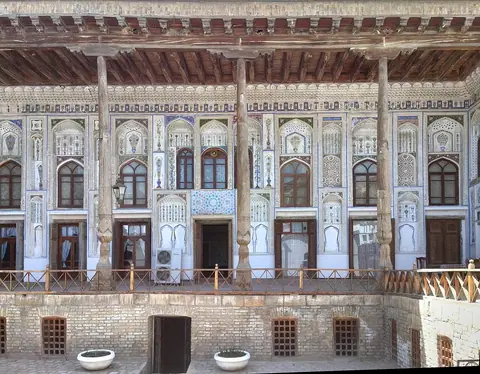
The combination is visible in details. Marble lions guard an entrance. The palace includes a ceremonial white hall with mirrors and carved ganch, the plaster used by local craftsmen. Chandeliers and furniture belong to another part of its furnishing history. This was a court choosing from several sources of luxury.
The new palace was built in the final years of the emirate, before the last emir lost power in 1920. It now houses a museum of decorative and applied arts. Understanding the rooms means paying attention both to the patron who used them and to the craftsmen whose work made them distinctive. An imported object and a locally decorated wall can tell different parts of that story.
A country residence built by several hands
The museum dates construction of the new palace to 1912 through 1918. Bukharan masters worked with the Russian engineers Margulis and Sakovich. Mirrors, tiled stoves, chandeliers and furniture were brought from Russia for the palace's decoration and equipment.
A room could use imported furnishings while its surfaces required the skills of local decorators. The commission depended on both.
Separate pavilions spread the residence through the garden, beyond the main ceremonial rooms.
Why the white hall is worth time
The white ceremonial hall combines mirror surfaces with ganch decoration. Ganch is worked into relief, so light catches its edges differently from the flat glass behind or beside it. The detail becomes clearer when you distinguish the materials instead of treating the room as one shining surface.
The national tourism account associates the palace's interior decoration with the masters Usto Shirin Muradov and Hassan Jana. Their names put makers back into a place usually introduced through its royal owner.
If the hall is accessible, choose a small area of ornament and look at how it repeats or changes. The overall effect is immediate, but the workmanship operates at a much smaller scale. The reflected surface and the carved relief produce different effects even when they share the same patch of light.
The museum changes the subject of the palace
The palace museum extends from court interiors to clothing, embroidery and household objects. Its collections include garments worked with gold thread and embroidered textiles associated with domestic life in the Bukhara region.
These objects ask a different set of questions from a reception hall. How was a room furnished? What was worn? Where did a decorated textile sit in an everyday interior? The palace provides a setting, but the displays concern a wider world than the emir's household.
The residence's royal use was brief compared with its later museum history. In these rooms, objects once gathered to furnish a court now help visitors examine the materials, tastes and labour of a larger region.
 🇺🇿
🇺🇿 🏰
🏰 🧱
🧱 💧
💧 🌳
🌳 🛍️
🛍️ 📚
📚 🏛️
🏛️ 🦁
🦁 🏠
🏠