A market built into the crossroads
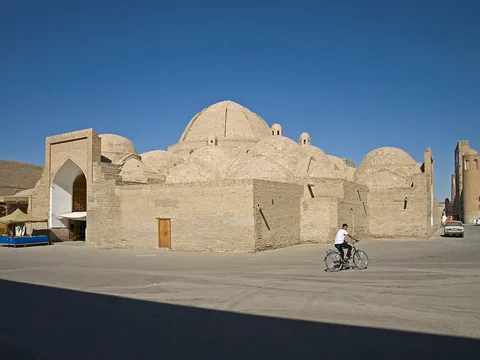
The trading domes of Bukhara, Uzbekistan, cover junctions in the old city's streets. They are buildings you pass through as well as places where people sell things. Their central spaces distribute movement into several directions, with smaller spaces for shops around them.
Three names preserve the trades once associated with these covered crossings. Toki Zargaron belonged to jewellers, Toki Telpak Furushon to sellers of headwear, and Toki Sarrafon to money changers. The surviving buildings are part of the great sixteenth-century expansion of Bukhara's commercial centre.
Look up before looking at the merchandise. A high central dome covers a meeting of routes, while lower vaults make room for trading around the edges. The useful question here is how to shelter a busy junction without stopping it being a junction. Each of the domes offers a slightly different answer.
The jewellers' dome opens four ways
Toki Zargaron stands near Poi Kalyan and the paired madrasas of Ulugh Beg and Abdulaziz Khan. Four vaulted passages meet beneath a large dome. Its octagonal base and ring of windows help turn the crossing into a recognisable room.
The scale allows two activities to coexist. People can continue through the central space while shops occupy its margins. Jewellers once made and sold their work here. The building brought production, display and passing customers close together.
Watch how the central opening relates to the smaller domes around it. The roof is not one broad cap laid over a rectangular market hall. Its parts correspond to a more complicated pattern of streets and shops below.
Hats, books and different currencies
At Toki Telpak Furushon, five streets approached at different angles. The plan had to gather that irregular movement into a covered centre. Its name recalls hats and other headwear, although an earlier association with books is also recorded.
The change of trade belongs to the building's working history. The building could stay while the things sold inside it changed. A name may preserve one successful period of its working life rather than the whole story.
Toki Sarrafon takes its name from the money changers. Merchants arriving with different currencies needed exchange as well as storage and selling space. The dome's association with that work brings another part of trade into view: goods had to be valued and paid for, not simply carried into the city.
A different kind of covered market
The nearby Tim Abdullah Khan, dated 1577, offers a useful comparison. A tim was an enclosed market building. Here, small openings light a central domed space and the surrounding galleries. Its association was with textiles and carpets.
Compare that arrangement with a street crossing under a toki. The relationship between enclosure and movement changes, even though both buildings use domes to cover commercial space.
Trade continues in the old city's domes, with fabrics, clothing and souvenirs among the goods offered. Present stock cannot be taken as proof of what an individual stall sold centuries ago, or where a particular object was made. Ask about a fabric's material and production if you are interested in buying it. The building supplies a historical setting; the seller can explain the object in your hand.
 🇺🇿
🇺🇿 🏰
🏰 🧱
🧱 💧
💧 🌳
🌳 🛍️
🛍️ 📚
📚 🏛️
🏛️ 🦁
🦁 🏠
🏠