More than a fortress wall
The Ark is the raised citadel of Bukhara, Uzbekistan. Behind its heavy outer walls, the rulers of the city lived and governed until 1920. Their residence shared the enclosure with officials, soldiers, stores and workshops. A fortress wall protected a working government as well as a palace.
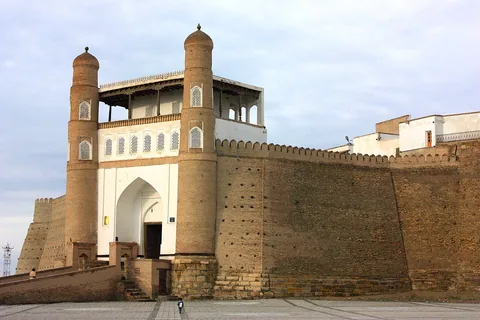
The entrance makes that separation visible. A ramp rises towards the western gate, so arrival involves climbing above the surrounding city. The surviving buildings inside belong to several later centuries, while the citadel itself has a much longer history of rebuilding.
Think of the Ark as a place repeatedly occupied and altered. Its great outline can suggest a complete, unchanging stronghold, but only part of its internal town survives. The spaces between the buildings are as important as the buildings themselves: they mark the difference between a densely occupied seat of power and the museum and archaeological site seen today.
The hill has more than one beginning
A founding legend gives the Ark to the prince Siyavush. Promised a king's daughter if he could build a fortress on an area covered by one bull's hide, he cut the hide into strips and used them to enclose a much larger space. It is a story about ingenuity, not a construction record.
The actual citadel was rebuilt many times. Its broad form developed under the Shaybanids in the sixteenth century; the surviving throne courtyard, mosque and service courts are later. There is no single date that explains every wall in front of you.
At the entrance, the mound, the enclosure and the gateway need not belong to the same campaign of work. A ruler could inherit the site and change the approach without beginning again from bare ground.
What a court needed around it
The Ark's surviving courts include a throne hall, the chief minister's quarters and a stable court. Their different uses become clearer when you consider the work around a royal household.
The enclosure also held stores and workshops. Cloth had to be stored, weapons maintained and horses cared for. Decisions announced in a ceremonial courtyard depended on work carried out in less conspicuous rooms.
The missing town after 1920
The Ark's eastern part was destroyed in 1920. The last emir, Alim Khan, fled to Afghanistan after the Red Army took Bukhara. This is the break between the Ark as a ruler's residence and the site that survives.
The Bukhara museum has occupied the citadel since 1945. Its displays put objects from the wider oasis inside the former seat of government. They can tell you about places and periods far beyond the rooms around them.
Outside, the walls still make a formidable boundary. Inside, the gaps show how much has gone. Holding those two views together gives a more accurate sense of the Ark than treating the enclosure as a fully preserved palace.
 🇺🇿
🇺🇿 🏰
🏰 🧱
🧱 💧
💧 🌳
🌳 🛍️
🛍️ 📚
📚 🏛️
🏛️ 🦁
🦁 🏠
🏠