Four towers were only the entrance
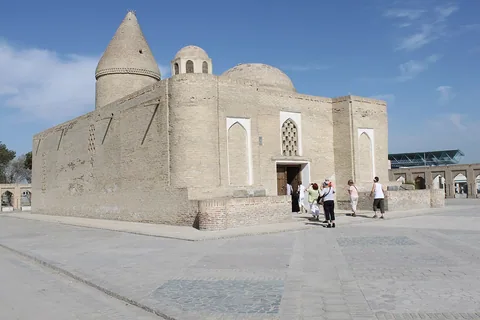
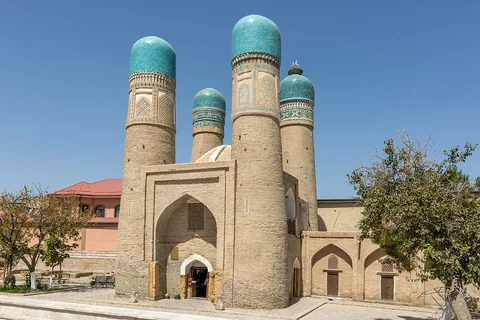
Chor Minor is the small building with four blue-capped towers in Bukhara, Uzbekistan. Its name means four towers or minarets, but the surviving structure makes more sense as a gateway. It was the entrance to a larger madrasa founded by Khalifa Niyazkul in 1807.
That is a relatively late date in a city where some of the best known buildings are medieval. The compact outline belongs to the period of Bukhara's emirate. Behind the gateway there was once a school arranged around a courtyard, with rooms for its students.
Try looking past the four towers towards the space the building introduced. Their appeal can make the gatehouse seem like a complete monument in itself. It is also a surviving piece of a larger institution. The towers frame that piece so effectively that the lost school can be easy to overlook.
A gateway with rooms above it
The four corner towers surround a square central structure. The gateway had two levels, with a domed room above the passage. The national tourism account identifies the upper room as a library and describes access by a stair within one tower.
This helps explain why the building should not be imagined as four small versions of the Kalyan Minaret. The towers belong to the organisation of a gatehouse with rooms and circulation inside it.
Their glazed decoration is worth comparing without immediately assigning a symbolic meaning to every difference. The unusual silhouette also enclosed practical spaces for the school.
One of the towers had to be rebuilt
The present outline also depends on modern repair. In 1995 one tower collapsed, destabilising the building. UNESCO provided emergency assistance, and reconstruction and consolidation followed between 1995 and 1997.
The contemporary UNESCO report criticised the use of nontraditional materials, including poor quality cement and steel, despite an agreement to use traditional methods. The report records a conservation dispute, not simply a successful return to an unchanged original.
That matters when considering what has survived. The four towers are again present, but their materials and history are not identical. The complete-looking silhouette contains a major episode of loss and reconstruction.
 🇺🇿
🇺🇿 🏰
🏰 🧱
🧱 💧
💧 🌳
🌳 🛍️
🛍️ 📚
📚 🏛️
🏛️ 🦁
🦁 🏠
🏠