The decoration is the building
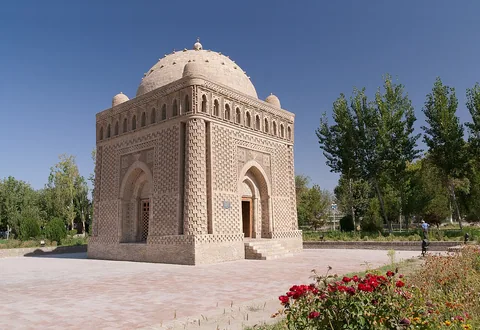
The Samanid Mausoleum in Bukhara, Uzbekistan, asks you to slow down in front of a small brick building. A dome covers a square chamber, and patterned brickwork covers the walls. There is no expanse of blue tile to pull your attention away from how it was built.
The tomb belongs to the late ninth or early tenth century and is traditionally associated with the Samanid ruler Ismail Samani and his family. Its exact patronage and the identification of the burials remain debated. The broad dating is more secure than a confident story about who ordered every part.
Compare two patches of wall. Bricks laid in different directions catch different amounts of light, so the surface can look almost woven. The decoration has depth. This makes the mausoleum particularly rewarding to look at from more than one angle: a short change in viewpoint can clarify a pattern that seemed flat a moment earlier.
Four sides without a grand front
The mausoleum has a central composition, with closely related treatment on all four sides. The corners carry rounded brick forms, and an open gallery runs beneath the roof. Those repeated elements hold the cube together visually.
The closely related facades keep the whole volume in view. No oversized portal screens the chamber from the street, as it does at many of Bukhara's later madrasas.
The forty openings of the upper gallery add a darker band near the top. Below it, the brick patterns change at a much smaller scale. The larger divisions remain clear even where small patterns change.
How a square carries a dome
If the interior is accessible, look towards the corners beneath the dome. Arched constructions called squinches help make the transition from the square chamber to the round covering above it. The builders turned a structural problem into another place for ornament.
You do not need the technical term to see the problem. A circle cannot simply sit along the four straight sides of a square. Intermediate shapes are needed. Here, the eye follows those changes upwards instead of meeting a sudden break between wall and dome.
This is also why the building rewards attention beyond its exterior patterns. Its proportions and transitions do useful work. The decorated corners belong to the way the chamber stands up.
A tomb that outlived its cemetery
The park setting is later than the mausoleum. This building once stood within a cemetery. Restoration campaigns in the twentieth century included substantial work in the late 1930s, and the surrounding burial ground was subsequently replaced by a park.
That history changes the apparent solitude. The tomb was not conceived as an isolated sculpture in an open garden. Other graves once gave it a different setting and a more immediate connection with burial and remembrance.
 🇺🇿
🇺🇿 🏰
🏰 🧱
🧱 💧
💧 🌳
🌳 🛍️
🛍️ 📚
📚 🏛️
🏛️ 🦁
🦁 🏠
🏠