One shrine, different kinds of authority
The Pahlavan Mahmud complex in Itchan Kala, Khiva, grew around the grave of a revered poet and craftsman. Tradition also remembers him as a powerful wrestler. Later Khiva khans chose the shrine as their own burial place, so the complex joins devotion to a saint with the memory of a ruling dynasty.
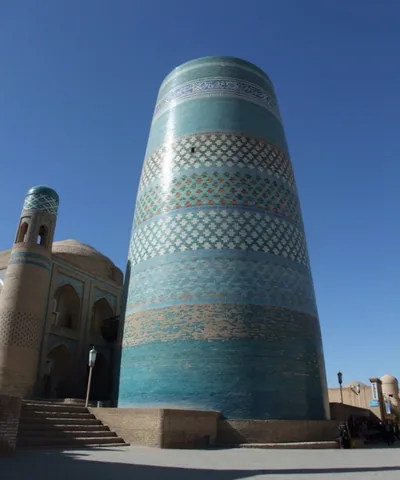
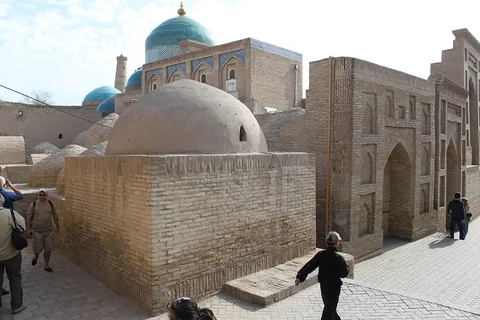
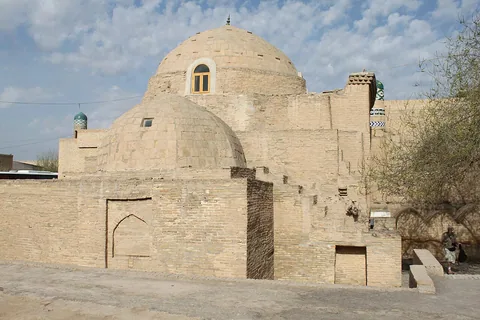
The large turquoise dome is easy to recognise above the town's lower roofs. The present ensemble developed long after Pahlavan Mahmud's lifetime, principally through nineteenth-century rebuilding and later additions. Keep those two times separate: the person commemorated here belongs to the medieval world; much of the architecture expresses the ambitions of later rulers and craftsmen.
A modest grave acquired more rooms
Uzbekistan's tourism authority describes an early, small mausoleum made of unfired brick. The building now associated with the shrine began to take its later form under Muhammad Rahim Khan I, with work continuing during Allakuli Khan's reign. A larger hall joined the saint's burial chamber, and the ensemble developed into a dynastic burial complex.
A visit therefore passes through spaces with different purposes. A burial chamber contains a tomb, while a ziyaratkhana provides a place for visitation and prayer. The larger domed hall allows the complex to hold more people and more memorials around the older focus of devotion.
The khans' presence did not replace Pahlavan Mahmud's. Their tombs drew a connection between royal memory and a shrine that people already revered. That relationship explains why a complex named for a poet contains so much of Khiva's dynastic history.
Read a wall before reading a whole room
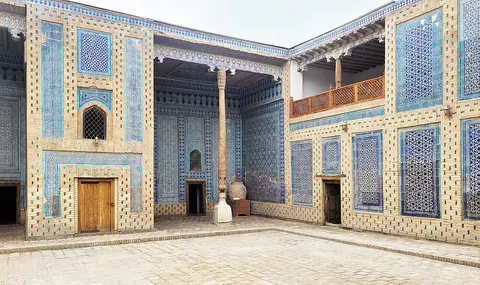
Where the interior is accessible, the blue and white majolica can seem to cover everything at once. Pick a small area. Follow the boundary between a plant pattern, a geometric field and a band of script. The borders make the dense decoration legible, even when you cannot read the inscription.
The official Uzbek account identifies poetry and ethical sayings among the inscriptions. Words and ornament share the surface. The room therefore carries more than a decorative covering: it also places religious and moral writing beside the graves.
Look upwards to the transition between the square room and its dome. The change in shape required the builders to carry a circular covering over an angular space. Decoration helps the eye follow that transition, but it rests on a real problem of construction.
Additions kept the shrine in use
The complex continued to change into the early twentieth century. Rooms for Quran recitation and a summer mosque expanded its functions. MIT's architectural collection records these later additions alongside the royal burials and nineteenth-century enlargement.
This remains a pilgrimage place. Allow worshippers space and follow the attendants' instructions in the rooms you can enter. Compare the exterior with the interior. From outside, a single dome identifies the complex. Inside, separate chambers, graves and passages reveal how it accumulated around one revered burial over generations.
 🇺🇿
🇺🇿 🏰
🏰 🕌
🕌 🔵
🔵 🏛️
🏛️ 🟦
🟦 🗼
🗼 📚
📚 🟩
🟩 💡
💡