Look at the pair
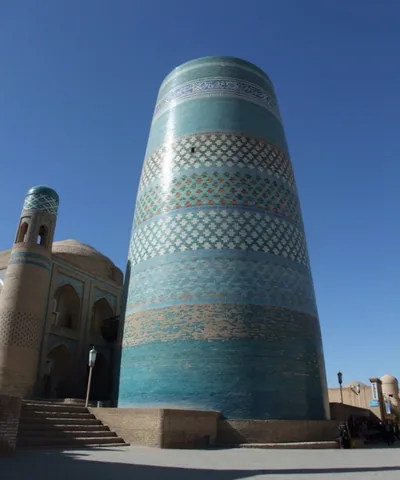
Kalta Minor is the broad, unfinished minaret beside Muhammad Amin Khan Madrasa in western Itchan Kala, Khiva. Both belong to the building ambitions of the same nineteenth-century ruler. The madrasa gives the tower its setting: a substantial teaching institution stands beside a minaret whose upward movement stops abruptly.
Construction of the minaret began in 1852 and ended after Muhammad Amin Khan's death in 1855. Its wide base was intended to support a much taller tower. Look at the glazed bands and then at the low, flat end of the shaft. The finished decoration and unfinished outline are both part of what you see. Neither needs an invented explanation to be striking.
A tall plan left a wide base
The name Kalta Minor means "short minaret". Its proportions explain the name. Its diameter is about fourteen metres at the base. A structure that broad would normally continue much further upwards before reaching a lantern or crown.
Uzbekistan's tourism authority describes a proposed height of eighty metres, with the shaft narrowing sharply as it rose. The exact planned dimensions vary in other accounts. The broad foundation and curtailed profile are enough to establish the central point: the present silhouette was not the intended completion.
Horizontal bands of turquoise, blue and lighter ornament wrap around the cylinder. Their continuity makes the circular form easy to follow. Compare that surface with the madrasa's facade, where decoration has to negotiate openings, arches and corners.
The school was more than a backdrop
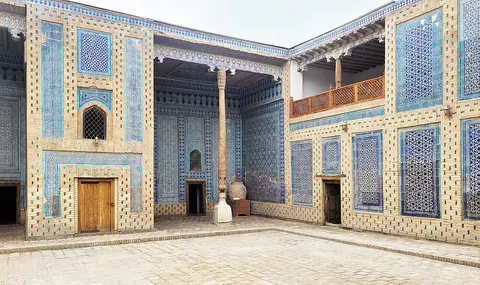
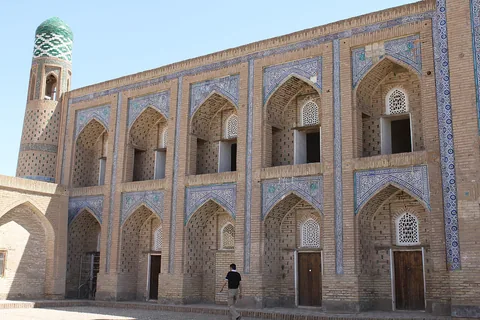
Muhammad Amin Khan's madrasa is a large building with two levels of student accommodation. The upper rooms have balconies; rooms below include subsidiary spaces. These details help bring the building down from the scale of a royal commission to that of daily residence.
A madrasa provided teaching as well as accommodation. Its cells were part of the institution's practical design. The facade's corner towers, domes and glazed ornament announced the patron's resources, but the repeated rooms tell you how the building could be occupied.
The tower and school therefore reward different kinds of looking. At the minaret, read the overall proportion and the bands around a single mass. At the madrasa, examine how a large facade breaks into individual bays. The same commission produced both a prominent marker and a building used at a more intimate scale.
A documented interruption and a legend
The ruler's death in 1855 is the documented interruption given by the national tourism account. That account also repeats a legend: an architect planned to work for the emir of Bukhara, feared the Khiva khan's retaliation and fled.
Muhammad Amin Khan also sent diplomatic missions to Russia and the Ottoman Empire. Research into his letters shows a ruler negotiating trade, property and political pressure. The unfinished minaret belongs within that active reign. It is a surviving project of a government with interests beyond the city walls, left without the ruler who began it.
 🇺🇿
🇺🇿 🏰
🏰 🕌
🕌 🔵
🔵 🏛️
🏛️ 🟦
🟦 🗼
🗼 📚
📚 🟩
🟩 💡
💡