A school opposite the citadel
Muhammad Rahim Khan II Madrasa faces Kunya Ark in Itchan Kala, Khiva. The ruler who commissioned it also wrote poetry under the name Feruz and supported books, scholars and musicians. His madrasa places that cultural patronage directly opposite the royal citadel.
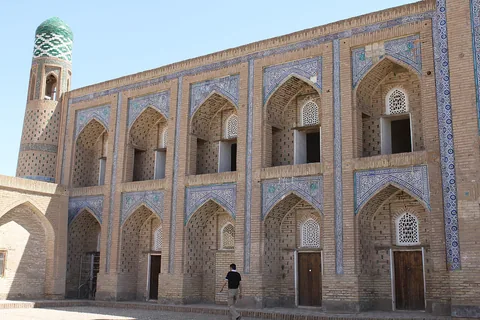
Look at the two levels of rooms and the large central entrance, then notice the smaller court before the main building. The approach gives the institution more than one boundary. The teaching spaces and residential cells sit behind a facade intended to be seen from the town. This late nineteenth-century madrasa makes education part of the ruler's public image.
Two courts make a gradual entrance
From the street, the first entrance leads into a forecourt with rooms along its inside. The main two-storey building then presents a second, larger portal. This sequence changes the scale of the approach: you have already crossed one boundary before confronting the principal facade.
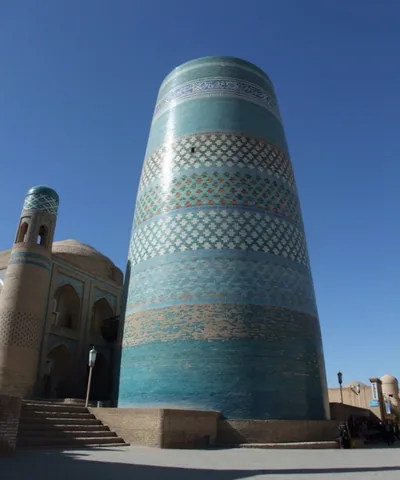
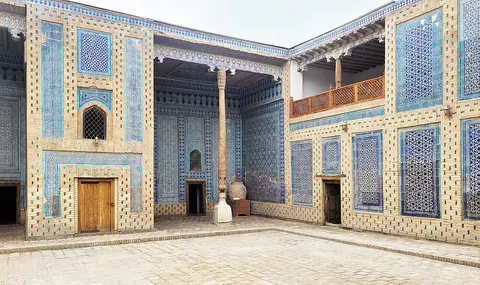
The corner towers end in green mosaic domes. Blue and white majolica covers the facade's decorated fields, while patterned brick appears in the vaulting. Compare the small openings of the rooms with the height of the main arch. One belongs to daily occupation; the other addresses the visitor at the scale of an institution.
The madrasa included a library, teaching rooms and spaces for prayer. Its hujras incorporated small service rooms beside the living space. That additional provision is an ordinary detail worth holding onto among the royal names and tilework. Students needed places to keep things and manage their daily needs.
Feruz's books had a political setting
Muhammad Rahim Khan II ruled when Russian forces conquered Khiva in 1873 and imposed a protectorate. His cultural activity continued under that political constraint. The library and patronage of scholarship therefore belong to a period of lost independence as well as artistic production.
Researcher Aftandil Erkinov studied the organisation of the khan's court library and the evidence of its manuscripts. He interprets the ruler's support for literary culture as a response to Russian domination.
The khan sponsored translation and the production of books. Printing joined manuscript culture during his reign. Patronage could support older literary forms while adopting a newer means of copying and circulating them. The court's book production combined handwritten copies with printed editions.
Keep the ruler and the institution in view
The madrasa was an act of royal display, but it also allocated rooms and resources to learning. Those purposes could exist together. The large portal made the founder's investment visible, while the repeated accommodation made the institution usable.
Across the way, Kunya Ark enclosed government and the ruler's household. The madrasa gave his name a presence in education, with rooms and resources for teachers, students and books.
 🇺🇿
🇺🇿 🏰
🏰 🕌
🕌 🔵
🔵 🏛️
🏛️ 🟦
🟦 🗼
🗼 📚
📚 🟩
🟩 💡
💡