A city with four ways in
Itchan Kala is the walled inner town of Khiva, in Uzbekistan's Khorezm region. Its four gates give you a simple way to understand the place: Ata Darvaza faces west, Palvan Darvaza east, Tash Darvaza south and Bagcha Darvaza north. The wall encloses a town of streets and houses as well as palaces and religious buildings. Khiva continues beyond it.
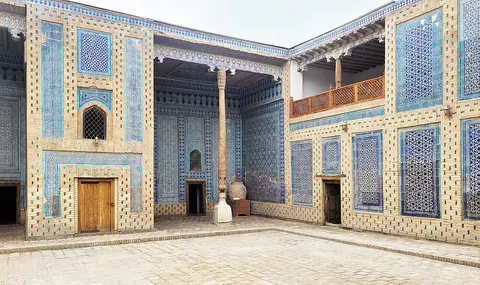
Use the west and east gates to place the main concentration of monuments in your mind. Kunya Ark, the older royal citadel, occupies the western side. Tash Hauli, Allakuli Khan's nineteenth-century palace, lies towards the east. Between them, palaces, schools and houses fit close together within one defensive boundary.
A gate was also an office
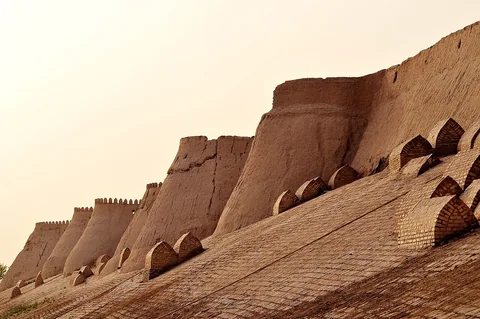
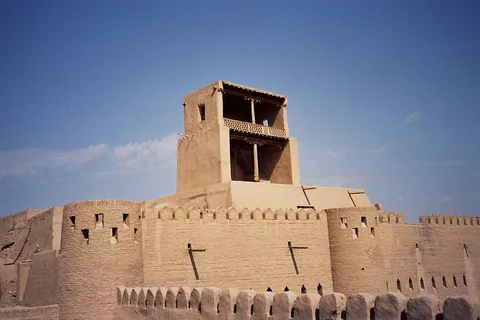
The walls have a broad, sloping mass, punctuated by projecting towers and a broken line of battlements. A gate interrupts that barrier while keeping movement under supervision. Its passage narrows the space through which a person, animal or load can pass. Look at the relationship between the opening and the flanking towers before looking up at the skyline.
Ata Darvaza makes the economic purpose of a gate particularly clear. Uzbekistan's tourism authority records a customs post and a currency exchange at the western entrance. Goods and money needed checking as well as admitting. The authority dates that gateway to the early nineteenth century and its reconstruction to 1975, under the master Samandar Kalandarov. Its appearance therefore includes a modern decision to recover an earlier form.
The four entrances make a practical compass, although they do not turn the town into a regular grid. After the monumental east-west axis, a smaller lane can change the scale abruptly. Houses and their boundary walls deserve attention alongside the large decorated portals.
Trade included the sale of people
Khiva's commercial history also includes slavery. Captives from Iran and the Russian frontier passed through the region's trading networks; enslaved people worked in households, crafts and agriculture. A caravan arriving at an oasis could carry people who had no choice about the journey.
Historian Jeffrey Eden's research uses former captives' accounts to recover their actions and resistance. His account of abolition gives enslaved people an active role in the events surrounding the Russian conquest of 1873. That history complicates a view of Khiva as simply a picturesque place of merchants and palaces. The walls enclosed unequal lives, and the surviving decoration tells only part of their story.
The streets inside the monument
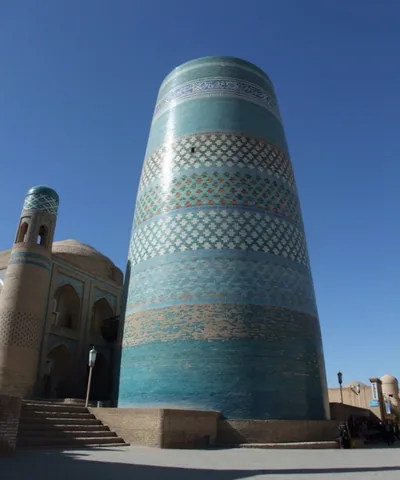
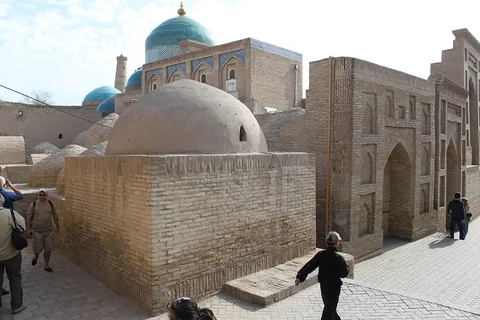
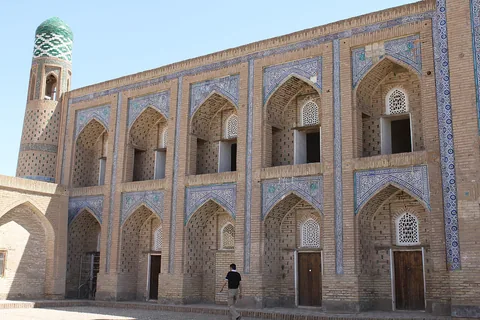
Itchan Kala entered the World Heritage List in 1990. UNESCO's assessment values the relationship between the buildings and the traditional town plan, including domestic architecture. The spaces between monuments help explain that judgement: a courtyard wall, a turn in a lane and the low roofs around a minaret all affect how the larger structures appear.
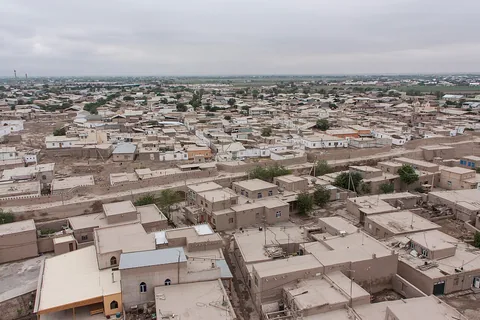
Families still live within Itchan Kala. A doorway may belong to someone's home. Keep to public spaces and leave private thresholds clear.
 🇺🇿
🇺🇿 🏰
🏰 🕌
🕌 🔵
🔵 🏛️
🏛️ 🟦
🟦 🗼
🗼 📚
📚 🟩
🟩 💡
💡