Start with the columns
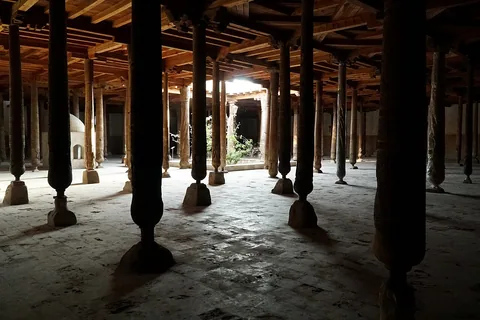
Juma Mosque is Khiva's Friday Mosque, near the centre of Itchan Kala. Its broad prayer hall has a flat roof supported by more than two hundred wooden columns. Look along a row, then compare neighbouring shafts. Their carving varies because the hall brings together timber from different periods.
The present building dates principally to a reconstruction in 1788 and 1789, on the site of a much older mosque. Some columns were reused. The roof and plan belong to one building campaign, while individual supports preserve a longer history.
A large room with little light
Many Central Asian religious buildings organise their spaces around an open court. At Juma Mosque, the congregation gathered under a continuous roof. Small openings admit daylight into an otherwise enclosed hall. The timber rows carry the roof across a space roughly fifty-five metres long and forty-six metres wide.
A column can appear solid when viewed across the rows, then open a narrow line of sight when you move a little. The repeated supports allow one large covered space, while the limited daylight makes the differences in carving easier to miss at first.
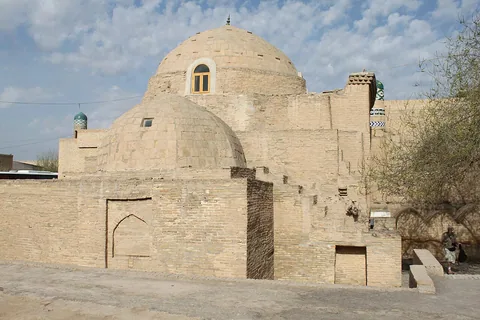
The plainness of the outside gives little warning of that interior arrangement. The building's character depends on its covered space and wooden structure more than on a monumental entrance.
Rebuilding with older material
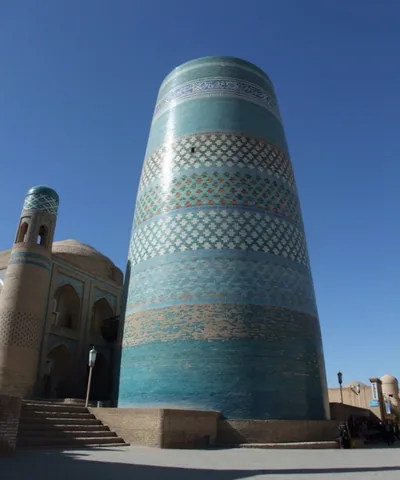
The architectural inventory maintained by IRCICA connects the late eighteenth-century reconstruction with Muhammad Amin Inaq. He is a different historical figure from Muhammad Amin Khan, whose nineteenth-century madrasa stands beside Kalta Minor. Similar names can make Khiva's building history seem more compressed than it was.
The inventory identifies columns from several earlier centuries. Compare the density and depth of the carving, the way bands divide a column and the treatment of its base. A change in pattern is something you can see; a precise date requires specialist evidence.
Reusing a support kept valuable material in service. It also brought older craft into the rebuilt hall. The different styles remain together under the same roof.
Wood needs care as well as admiration
Columns carry loads, but they also suffer from age and wear. IRCICA's survey records deterioration in timber and stone bases. The mosque's survival therefore depends on repair and conservation as much as on the durability of its original materials.
Give the carving room. Do not lean against it or run a hand over a pattern to test its depth. The differences are visible without touching. If you return your attention to the whole hall after studying one column, the room becomes easier to understand: an eighteenth-century rebuilding held up by a collection of supports with different histories.
 🇺🇿
🇺🇿 🏰
🏰 🕌
🕌 🔵
🔵 🏛️
🏛️ 🟦
🟦 🗼
🗼 📚
📚 🟩
🟩 💡
💡