Three mausoleums with different stories
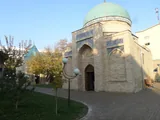
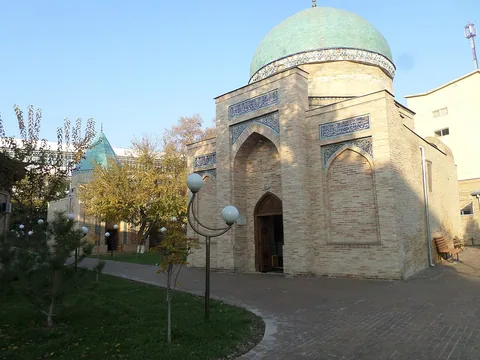
The Sheikhantaur complex gathers three historic mausoleums in central Tashkent: those of Sheikh Hovendi at-Tahur, Kaldyrgach-biy and Yunus Khan. Their proximity does not mean they were built together or commemorate the same kind of person.
The ensemble developed around the burial of Sheikh Hovendi at-Tahur, a fourteenth-century Sufi figure. Later burials and buildings added other connections. The site is a good place to look closely at the different forms a memorial building can take.
Start by comparing rooflines rather than trying to remember every name at once. The low domes of the sheikh's mausoleum and the pointed, tent-like roof of Kaldyrgach-biy make a clear contrast. Access to the Yunus Khan mausoleum is more restricted because of its institutional setting. The collection explains all three, but does not promise that every interior can be visited.
A place shaped by devotion
Sheikh Hovendi at-Tahur lived and taught in Tashkent. His burial became the focus of a larger sacred landscape. Restoration and rebuilding later changed the appearance of the mausoleum, so its present surfaces cannot all be treated as fourteenth-century fabric.
The site also carries stories about a surviving tree trunk associated with Alexander the Great. Treat that association as a local legend, rather than a verified record of who planted a tree. A tradition can explain how people have understood a place without becoming archaeological proof.
If you visit, remember that these are burial and pilgrimage spaces. Quiet observation and following local instructions matter more than getting close to every object mentioned in a guide.
A pointed roof and a connection across the steppe
The Kaldyrgach-biy mausoleum is associated with Tole-biy, a Kazakh statesman. Its pointed roof differs from the rounded domes many visitors expect from Uzbekistan's monuments.
That difference gives you something specific to compare. Look at how the roof rises from the building beneath it, and how the whole outline changes as you move to another permitted viewpoint. The national tourism board connects its form with mausoleum traditions of the steppe.
Architecture does not follow today's national borders neatly. A building in Tashkent can carry the memory of a Kazakh figure and refer to forms found elsewhere in Central Asia. The connection is more informative than treating an unusual roof as a decorative curiosity.
Yunus Khan and the limits of a visit
The late fifteenth-century mausoleum of Yunus Khan adds a dynastic story. He was a ruler of Moghulistan and the grandfather of Babur, who founded the Mughal Empire in South Asia. These names connect the site with political histories extending well beyond Tashkent.
The city administration describes this mausoleum as lying within restricted university grounds. Check current access rather than assuming that a landmark pin permits entry. You can understand its place in the ensemble without crossing a closed gate.
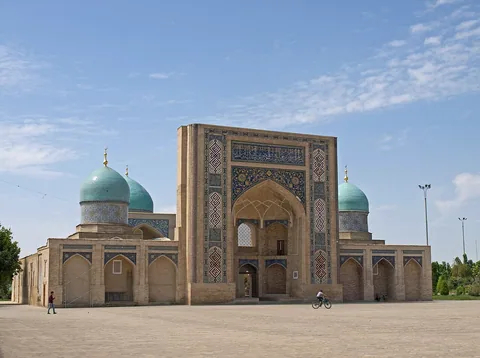
For a second religious district, compare Sheikhantaur with Khast Imam. Both developed around a remembered scholar's burial, but their surviving buildings and later institutions differ. Give each its own history. Tashkent's older places become easier to understand when they remain particular places, rather than examples of one general story about domes and tiles.
 EXPLORE THE CITYTashkent city guideRead the city guide ↗
 🕌
🕌 🧺
🧺 🕌
🕌 🚇
🚇 🌳
🌳 🏛️
🏛️ 🎭
🎭 🌳
🌳 🏛️
🏛️ 🕌
🕌