A theatre built for more than its façade
The Alisher Navoi Theatre is Tashkent's opera and ballet theatre. Its present building opened on 6 November 1947 to a design by Alexey Shchusev. The institution's performance history began earlier, so the building's opening and the company's beginnings are different dates.
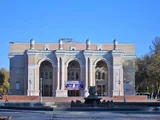
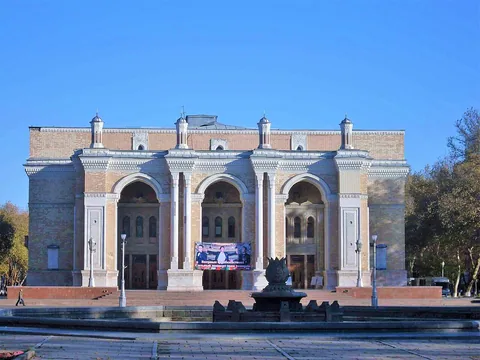
From outside, the entrance arcade gives the theatre an unmistakably public front. It prepares for people arriving together, then passing into a performance space. The building makes more sense when you imagine that movement rather than treating it only as an ornamental palace.
Its construction also connects Uzbekistan and Japan. Japanese internees worked on the theatre after the Second World War, a contribution acknowledged by Japan's embassy. That history belongs beside the architecture and performances. It should not be turned into a romantic story that forgets the circumstances of the workers' presence.
The company came before this building
The national tourism board traces the theatre's roots to an earlier performance ensemble associated with Muhiddin Kari-Yakubov and Tamara Khanum. An Uzbek opera company developed before the new building was ready.
The theatre's own anniversary account records the 1947 opening with a performance of The Valley of Happiness by Mukhtar Ashrafi and Sergei Vasilenko. That gives the inauguration an actual work and audience, rather than leaving it as a construction date.
A theatre is unusual among monuments because its intended use keeps producing new events. The architecture stays in place while programmes, casts and audiences change. A visit for a performance and a look from the square are therefore different encounters with the same building.
The people behind the construction
Shchusev's design was realised through the work of many builders and craftspeople. Among them were Japanese people interned in the Soviet Union after the war. The Japanese embassy's account of a later official visit explicitly acknowledges their contribution.
Keep that wording in mind. They were not simply foreign volunteers invited to an architectural collaboration. The human circumstances matter even when the surviving building is admired.
The theatre later became a setting for cultural exchanges between Japan and Uzbekistan. A concert can make a building's history part of a present relationship. It does not erase the earlier history, but it offers another way for it to be remembered.
Look at the approach, then choose your visit
If you are outside, notice how the arcade shades the entrance and creates a transition between open square and interior. Repeated openings give the frontage a rhythm, while the central approach helps arriving visitors orient themselves.
You can appreciate those decisions without assuming the doors are open for sightseeing. Interior access and performance tickets are separate arrangements. Use the theatre's official programme for current productions, dates and booking information; this guide is not a ticket.
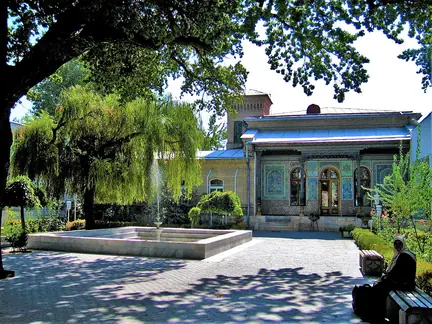
The Museum of Applied Arts offers a useful comparison. There, decorated rooms belonged to a private residence before becoming a museum. Here, craftsmanship serves a building designed for collective performance. In each, ask how the decoration relates to the activity the room was made to hold.
If you do attend a performance, let the building support the evening. Arrive with enough time for the venue's instructions, find your seat and give the work on stage your attention. The theatre's continuing purpose is part of its history.
 EXPLORE THE CITYTashkent city guideRead the city guide ↗
 🕌
🕌 🧺
🧺 🕌
🕌 🚇
🚇 🌳
🌳 🏛️
🏛️ 🎭
🎭 🌳
🌳 🏛️
🏛️ 🕌
🕌