A medieval ruler in a modern capital
The equestrian monument at Amir Temur Square commemorates the ruler also known in English as Timur or Tamerlane. The statue is modern: it was installed after Uzbekistan became independent, rather than surviving from his medieval empire.
That distinction is the way into the square's story. A national capital can choose a figure from the distant past to explain something about itself in the present. Here, a mounted ruler, a prominent pedestal and a nearby museum make that choice visible.
Look first at the relationship between the statue and the space around it. The horse and rider have been placed to be seen from several approaches. Then read the name and motto on the pedestal if you can. The sculpture identifies a person; its setting turns that person into the focus of a civic place.
Why the 1990s matter here
The Islam Karimov Foundation records the Tashkent equestrian statue as a 1993 installation. Sources differ on some of the ceremony dates, so this guide keeps to the securely documented year rather than attaching an exact day to it.
The State Museum of the Temurids opened nearby in 1996, during the commemoration of Temur's 660th birth anniversary. Together, square and museum belong to the way independent Uzbekistan gave his dynasty a prominent public presence.
They also do different work. The statue presents one recognisable figure in an open space. A museum can use objects, pictures and text to develop a longer account. Seeing one does not mean that you have visited the other, and museum admission must be arranged separately.
Read the gesture and the wording
Kamol and Ilkhom Jabbarov created the equestrian monument. Temur holds the reins with one hand and raises the other. The motto is commonly translated as "Strength is in justice" and appears in several languages.
Consider what that combination asks a viewer to notice. A horse and military dress establish authority, while the wording makes a claim about how that authority should be understood. The monument is presenting a commemorative interpretation of its subject.
Historian Elena G. Paskaleva's study of the neighbouring museum examines this connection between historical commemoration and contemporary national identity. You need not agree with every message in a monument to understand why its sponsors chose to place it at the centre of a capital.
Give the surrounding city a look too
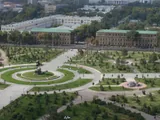
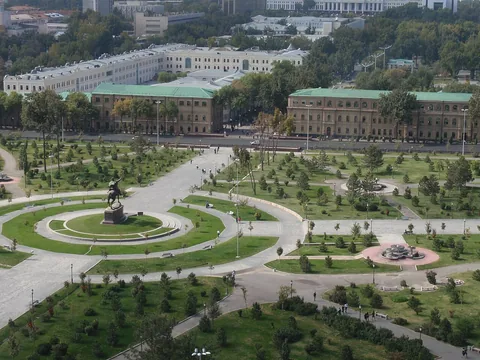
The square sits among buildings from different periods, including Hotel Uzbekistan and the nearby museum. Their relationship prevents the setting from reading as a recreation of a medieval city. This is a modern Tashkent space using a historical figure as its focus.
From a safe public path, compare the scale of the monument with the buildings beyond it. Move enough to see how the backdrop changes. An isolated close-up and a wider view answer different questions: what does the statue look like, and where has the city chosen to put it?
Independence Square makes a useful second stop in the collection. Both places explain the capital's public identity after 1991, but one centres a named ruler and the other uses a globe, a mother and child, and ceremonial landscaping. Read them as two different choices about how to picture a country.
 EXPLORE THE CITYTashkent city guideRead the city guide ↗
 🕌
🕌 🧺
🧺 🕌
🕌 🚇
🚇 🌳
🌳 🏛️
🏛️ 🎭
🎭 🌳
🌳 🏛️
🏛️ 🕌
🕌