A school above the trading district
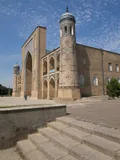
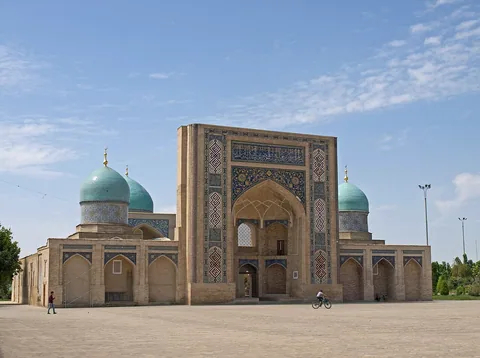
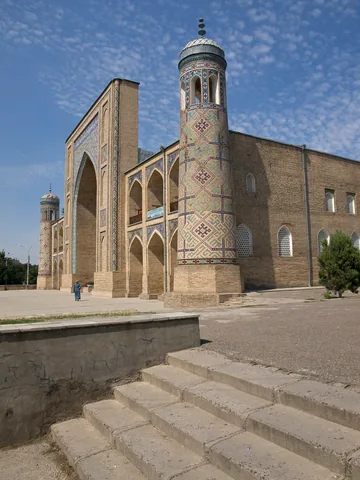
Kukeldash is a sixteenth-century madrasah beside the Chorsu area of Tashkent. A madrasah is a place of learning, and that function gives the building more meaning than its tall tiled entrance alone.
Its exact foundation is less tidy than a date on a travel checklist. The national tourism board places construction in the middle of the sixteenth century. Research into a surviving 1569 endowment deed shows the institution already receiving property income by then. The evidence supports a school established in that period without requiring an invented exact opening day.
The building has been damaged, put to other uses and restored. Today's frontage is therefore part of a long history of repair. Begin with two questions: how did a school support its work, and how did the building survive when its original use was interrupted? The answers connect this monument to the market and streets around it.
A document connects education to commerce
Historian O‘ktam Sultonov examined an endowment deed associated with Darvish Muhammad Bahodir Sultan. The document describes commercial property assigned for the benefit of the madrasah, including shops and spaces for travellers and their animals.
An endowment, or waqf, could support an institution through income from property. That makes the relationship between this school and the trading district concrete. Learning needed money for buildings and people; commercial activity could help provide it.
The deed also explains why a single familiar founder story is not enough. Names and patronage in later accounts can become simplified. A dated document gives historians another kind of evidence to test against those accounts. The uncertainty is useful: it shows how we know a building's history rather than simply repeating its nickname.
The courtyard had work to do
The entrance leads into a courtyard surrounded by rooms, with spaces for teaching and worship. If you can enter, compare the scale of the portal with the repeated openings inside. The public face is much larger than any one room used in daily life.
That contrast is part of the institution's design. A commanding entrance identifies it from the street, while smaller spaces organise the people within. You do not need to recognise every decorative motif to understand that relationship.
The tourism board's account describes damage from earthquakes and changes of use, including a period as a caravanserai. Restoration recovered the building's form after serious losses. Its present appearance should not be treated as a complete set of untouched sixteenth-century surfaces.
A historic building with a present purpose
Kukeldash again functions as a religious educational institution. Visitor access is separate from that daily work. Follow the institution's current instructions, and do not assume that a courtyard or classroom can be entered because it appears in a photograph.
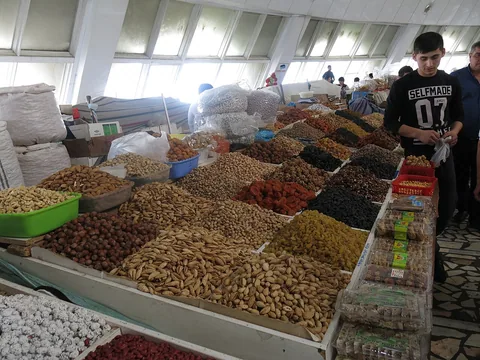
For a useful next comparison, look at Chorsu's modern market buildings. The bazaar and the madrasah have different ages and purposes, but both belong to the same working district. One organises trade; the other makes clear that trade could also support learning.
There is another Kukeldash Madrasah in Bukhara. This guide and map pin refer specifically to the Tashkent building. Keep that distinction when checking photographs or visitor information: a shared name does not make their founders, plans or histories interchangeable.
 EXPLORE THE CITYTashkent city guideRead the city guide ↗
 🕌
🕌 🧺
🧺 🕌
🕌 🚇
🚇 🌳
🌳 🏛️
🏛️ 🎭
🎭 🌳
🌳 🏛️
🏛️ 🕌
🕌