The house is part of the collection
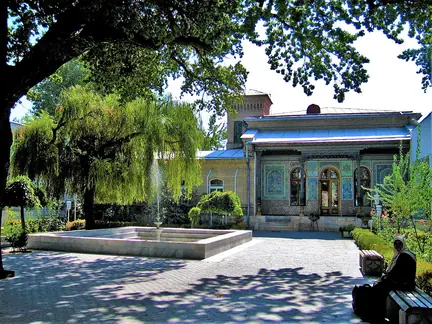
Tashkent's Museum of Applied Arts is housed in the former Polovtsov residence. Before looking at a case, look at the building itself: carved wood, painted surfaces and decorated plaster give you examples of the skills the museum exists to explain.
The residence took its richly decorated form after the Russian official Alexander Polovtsov bought it in 1896. Local craftspeople worked on the interiors. The setting therefore brings a personal commission and the work of Uzbek makers into the same story.
Applied arts are objects made to do something as well as to be looked at. Clothing, ceramics, jewellery and musical instruments have uses. Choose one and ask how its pattern or material works with that use. This is a museum where the shape of a vessel or the construction of a garment can be as revealing as an impressive date.
A private commission became a public setting
The city administration's history records the house's sale to Polovtsov and its rebuilding with local decorative work. Ganch plasterwork, carved wooden columns and painted ceilings turned the rooms into a substantial commission for skilled makers.
That helps you avoid a misleading division between a Russian house and Uzbek objects put inside it later. Local craft is already present in the rooms. The building's history is also a history of who could commission that work and how it was displayed.
If you have access to an interior, follow one material across the room. Notice where carved wood is structural, where it frames an opening and where it is mainly decoration. The same material can do several jobs without becoming less useful or less carefully made.
Objects made to be used
The collection includes ceramics, embroidery, clothing, skullcaps, carpets, jewellery and instruments. It reaches from the nineteenth century into more recent craft production. These categories are an invitation to compare purposes, rather than a requirement to see every case.
A textile can be read at several distances. From farther away, its overall pattern is clear. Close up, you may be able to see stitching, joins and the relationship between a repeated motif and the edge. Let the label establish the object's place and date; appearance alone cannot reliably identify a region or a maker.
For ceramics, begin with the opening, base and handles before the painted surface. Those parts give clues to handling and use. A museum case changes how an object is encountered, but its earlier practical purpose is still worth asking about.
Compare the room and the object
The national tourism board traces the museum's beginnings to a 1927 exhibition of craft work. Its later status and collections grew from that history of presenting makers' skills to a wider public.
The residence and the exhibits let you compare two scales of commission. A decorated ceiling was made for a particular room; a vessel or garment could move with its owner. Both require choices about material, labour and appearance. Their different sizes should not decide which receives your attention.
Pair the museum with Chorsu if you want to think about the difference between craft in a display and goods being bought and used. A museum label and a conversation with a seller provide different kinds of information. Neither makes every object a timeless example of one fixed national style.
Check the museum's current admission and photography instructions before visiting. This guide does not promise that a particular object or room will be on view. It gives you a way to look closely at what is available.
 EXPLORE THE CITYTashkent city guideRead the city guide ↗
 🕌
🕌 🧺
🧺 🕌
🕌 🚇
🚇 🌳
🌳 🏛️
🏛️ 🎭
🎭 🌳
🌳 🏛️
🏛️ 🕌
🕌