A district gathered around a scholar
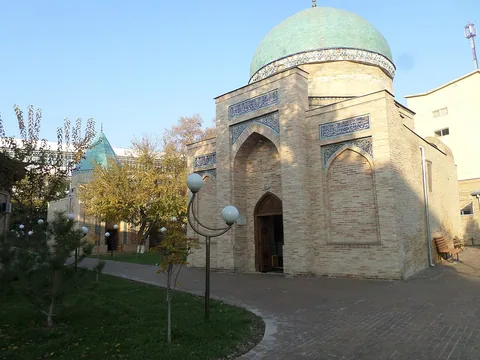
Khast Imam, also written Hazrati Imam, is a religious complex in Tashkent's old city. Its buildings gathered around the burial place of Abu Bakr Kaffal ash-Shashi, a scholar remembered in the city's Islamic history. A mosque, a madrasah and a mausoleum do different jobs here; this is more than one large building with several entrances.
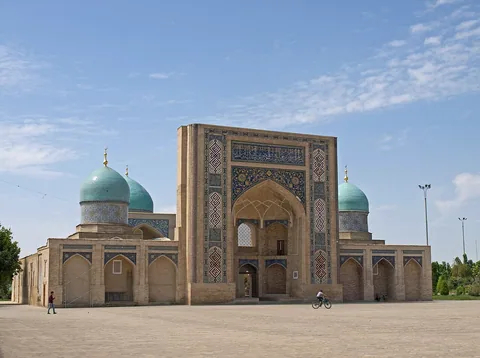
Barak Khan Madrasah is one of the historic elements. Its tiled entrance and courtyard belong to a sixteenth-century school. Other structures and the open spaces around them have changed over time. A restored surface or a recent building should not be mistaken for evidence that the whole square was built at once.
Begin by separating those functions. A mausoleum preserves a burial and a person's memory. A madrasah provides a place of learning. A mosque serves worship. The complex makes more sense when you can recognise the activities that brought people here, rather than looking only for blue domes.
Why the name belongs to a person
The national tourism board identifies Kaffal ash-Shashi's burial as the focus around which the ensemble developed. The connection between a respected scholar and a place of pilgrimage helps explain why later institutions were gathered nearby.
The complex includes the Kaffal ash-Shashi Mausoleum, Tillya Sheikh Mosque and Barak Khan Madrasah. They need not be encountered in a fixed order. If you have limited time, choose one building and work out its purpose before moving to the next. That is more useful than treating all the entrances as interchangeable architectural scenery.
These remain religious spaces. Follow local guidance about entry, dress and photography, and leave people room to pray or visit a tomb. An open courtyard does not mean every door beyond it is open to visitors.
A school and its patrons
The sixteenth-century Barak Khan Madrasah is associated with Nauruz Ahmed Khan, known as Barak Khan. It also incorporates mausoleums. That combination is a reminder that teaching, patronage and commemoration could occupy the same complex.
Look at the contrast between the tall entrance front and the smaller openings around the courtyard, if access allows. The entrance announces the institution to the city. The repeated rooms organise the more ordinary work behind that announcement. A photograph of the façade tells only one part of the story.
For a comparison, use the Kukeldash guide near Chorsu. Both places help explain how religious learning belonged within Tashkent's urban life. Their different settings also keep the old city from becoming a single, undifferentiated collection of monuments.
The manuscript story needs a separate check
The complex is closely associated with the Qur'an traditionally known as the Mushaf of Uthman. UNESCO entered the manuscript in its Memory of the World register in 1997. That is recognition of documentary heritage, not a declaration that the whole architectural complex is a World Heritage site.
Do not plan a visit around an old photograph of the manuscript's display. Official information about the nearby Center of Islamic Civilization describes a dedicated Qur'an hall, and display arrangements in this area have been changing. Check the current venue and admission instructions before travelling specifically to see it.
The architectural visit does not depend on that one object being on view. The school, burial place and places of worship already explain why this part of Tashkent became a centre for religious knowledge and memory.
 EXPLORE THE CITYTashkent city guideRead the city guide ↗
 🕌
🕌 🧺
🧺 🕌
🕌 🚇
🚇 🌳
🌳 🏛️
🏛️ 🎭
🎭 🌳
🌳 🏛️
🏛️ 🕌
🕌