A country pictured in a public space
Independence Square, or Mustaqillik Maydoni, is one of Tashkent's principal ceremonial spaces. Its monuments, planting and approaches help explain how the capital presents Uzbekistan's independence in public.
The central imagery includes a globe carrying the outline of Uzbekistan and a mother with a child. Nearby, the Ezgulik arch uses a long colonnade crowned with birds. You do not need a full history of the country's government to begin reading those choices: territory, family and peaceful aspiration have been given visible forms.
The square also contains spaces of war remembrance. Keep the independence monument and the Mourning Mother memorial distinct. They refer to different experiences, even though they belong to the same wider landscape. Reading their separate purposes is more useful than gathering every sculpture into one general story about national pride.
A square whose name changed
The city tourism service records several earlier names, including Cathedral Square and, later, Lenin Square. The present name followed Uzbekistan's independence in 1991. Changing the name changed what visitors were being asked to remember here.
The space itself also changed. Reconstruction after the 1966 earthquake enlarged and reorganised the square. The present setting therefore combines a Soviet-era urban scale with later monuments and meanings.
That is a helpful way to approach it: public places can keep an inherited layout while changing their centre of attention. A new inscription or sculpture may give an existing approach a different destination.
Follow the images at two scales
The globe presents the country on a worldwide scale. The mother and child bring the message down to a family relationship. Consider them separately before reading them as one ensemble. One identifies territory; the other supplies a human figure through which a viewer can relate to the idea of a young state.
The Ezgulik arch is another kind of threshold. Its repeated columns create an approach, with bird imagery above. The national tourism board connects those birds with peace and aspiration. A ceremonial gateway marks movement into a space even when it is not a defensive barrier.
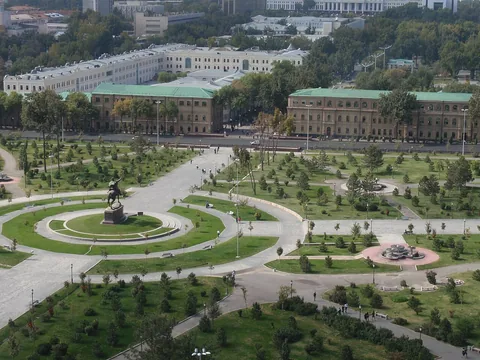
From an allowed path, notice how the monument becomes more or less prominent as you move. The planting, open ground and approaches are part of its presentation. A sculpture's meaning depends partly on how people are led towards it.
Remembrance has a different pace
The memorial area includes names of people lost in the Second World War, an eternal flame and the Mourning Mother. Here, the focus shifts from the future of a state to the absence of particular people.
Give that change of purpose some space. You do not need to photograph every part of the complex to understand it. Reading a few names or observing how others approach the memorial may be a more appropriate encounter than moving straight through a sightseeing list.
For a related comparison, use the Courage Monument guide. It also turns a collective experience into human figures, but remembers the 1966 earthquake and the rebuilding that followed. Amir Temur Square offers another contrast, with a single named historical ruler at its centre.
Ceremonies, security arrangements or maintenance can affect public access. Follow current instructions and keep clear of restricted administrative buildings. The map pin is a reference for the square, rather than a guarantee of a particular entrance or an unrestricted route.
 EXPLORE THE CITYTashkent city guideRead the city guide ↗
 🕌
🕌 🧺
🧺 🕌
🕌 🚇
🚇 🌳
🌳 🏛️
🏛️ 🎭
🎭 🌳
🌳 🏛️
🏛️ 🕌
🕌