The clock has stopped at the earthquake
Tashkent's Courage Monument remembers the earthquake of 26 April 1966. A dark stone block records the date and the time, 5:23 in the morning. A split runs through it and continues across the ground towards a family group.
The monument was unveiled in 1976, ten years after the disaster, and was created by sculptor Dmitry Ryabichev. It commemorates both the shock of the earthquake and the work of rebuilding. The family gives the event a human scale; the surrounding reliefs turn attention towards collective effort.
Begin with the clock, then follow the line of the crack. Those two details explain the composition before you need to know every figure. Time marks a sudden interruption. The line connects a damaged object to people whose lives were disrupted. This is a memorial to an event, rather than a surviving piece of earthquake damage.
A disaster with a long aftermath
The earthquake damaged housing and left a very large population without homes. Reconstruction involved workers and assistance from across the Soviet republics. New buildings and districts changed the city in which people would live afterwards.
A US Geological Survey report describes repeated tremors during 1966, as well as the vulnerability of older adobe and mud-brick buildings. That helps explain why the event cannot be reduced to one brief movement of the ground. The main shock was followed by an extended period of uncertainty, repair and rebuilding.
Avoid assuming that everything modern in Tashkent dates directly from the earthquake, or that everything old disappeared. The city continued to change for many other reasons. The memorial provides a starting point for that history, not a complete explanation for every building around you.
Read the figures and the reliefs separately
The family group includes a woman holding a child and a man making a protective gesture. These are deliberately legible poses. They do not reconstruct an identified household at an exact moment; they give a collective experience a recognisable human form.
The reliefs behind the group show people involved in rebuilding. Their position expands the story from the immediate family to the work carried out across the city. Notice the difference between the isolated stone block and the many figures in that wider composition.
You can read the arrangement without assigning a single emotion to everyone who visits. A public memorial offers a shared setting, but people bring different knowledge and memories to it. Leave room for that, especially around visitors who have come to commemorate rather than sightsee.
Carry the question into the city
After seeing the monument, look again at the mix of old neighbourhoods, broad roads and later public buildings elsewhere in Tashkent. Ask when each was made and what purpose it served. The earthquake is one part of those answers.
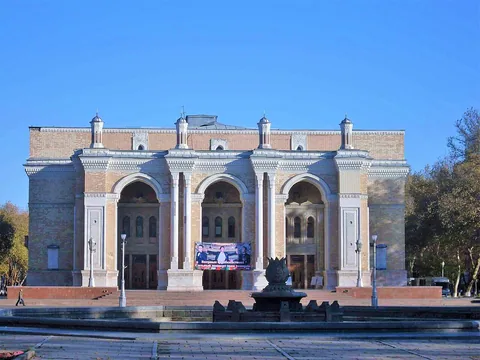
The theatre offers a useful comparison because its building opened before 1966. Chorsu's present covered market ensemble came much later, in the 1980s. Their separate dates prevent reconstruction from becoming a vague label attached to everything you see.
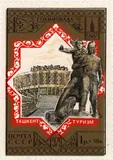
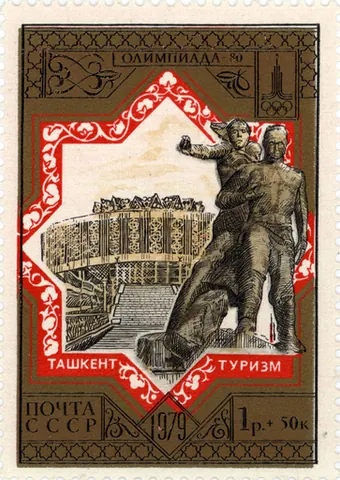
The illustration accompanying this guide is a 1979 Soviet postage stamp depicting the memorial, clearly identified in the image credit. It is an archival representation, not a current photograph of visitor access. Check local conditions and use public paths when approaching the monument.
 EXPLORE THE CITYTashkent city guideRead the city guide ↗
 🕌
🕌 🧺
🧺 🕌
🕌 🚇
🚇 🌳
🌳 🏛️
🏛️ 🎭
🎭 🌳
🌳 🏛️
🏛️ 🕌
🕌