A post office that became a history museum
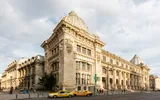
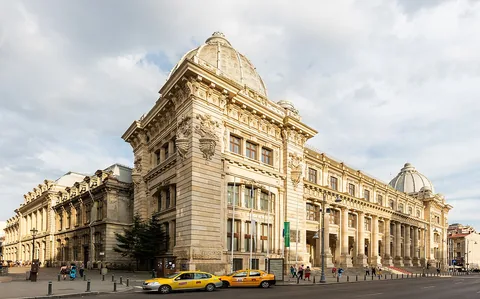
The National Museum of Romanian History occupies Bucharest's former Palace of the Post on Calea Victoriei. Alexandru Săvulescu designed the building in the 1890s for the postal service. The museum opened here in 1972.
Its setting offers a useful contrast. A post office moved messages through a modern state; a national museum selects objects through which to explain that state's past. The monumental entrance belongs to the first purpose, even though it now introduces the second.
Two of the museum's established displays give you very different ways into history: the Historical Treasury and a full-size copy of Trajan's Column. One brings precious objects close enough to inspect. The other brings scenes from a Roman monument down from their original height. Check the museum's current exhibition information before visiting, since the building's size is not a promise that every gallery is open.
Why the postal service needed a palace
The government approved the project in 1892. Săvulescu and the postal director travelled to study European postal buildings, and the museum's history identifies Geneva's post palace as the selected model. Construction began in 1894.
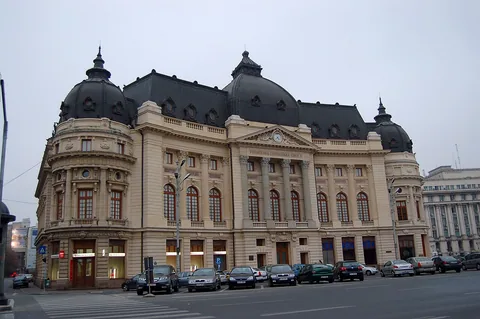
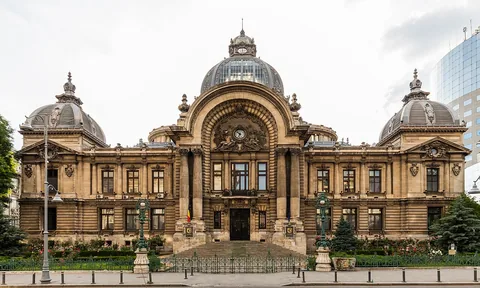
The façade presents the institution with a broad columned entrance rather than an ordinary shopfront. It made an everyday service look substantial and permanent. Across the street, CEC Palace does something comparable for savings and banking. These buildings help explain why central Bucharest has so many imposing nineteenth-century public fronts.
You can make that comparison from outside without entering either building. Look at how the entrances organise approach, and how much space each gives to announcing the institution. Their present names can obscure the jobs they were first built to do.
A Roman column you can read at eye level
The original Trajan's Column stands in Rome and depicts the emperor's wars against the Dacians in the early second century. Bucharest's version is a copy made in the Vatican workshops between 1934 and 1940. It reached Romania in 1967 and moved into this museum in 1972.
The display spreads the scenes out so that details can be examined. That changes the viewing experience: an image that spirals far above the ground in Rome becomes something you can follow at a much more practical distance.
Look for what a scene is doing as well as what it shows. Soldiers, equipment and engineering can offer historical evidence, while the overall sequence presents an emperor's victory. The museum itself discusses the tension between reading the reliefs as a record and reading them as a work of Roman public art. Both questions are worth keeping in mind.
Precious objects with different purposes
The Historical Treasury brings together jewellery, ceremonial objects, religious pieces and royal possessions. Gold alone does not explain them. A crown, an ornament worn on clothing and a vessel used in a ceremony did different jobs, even if they share a material.
Start with the object's form and its label. Ask who could use it, how it was worn or handled, and what the findspot tells you. That approach gives a small object more meaning than simply noting that it is old or valuable.
The collection spans communities and periods that cannot all be described as one unchanged nation. A national museum brings them into a present-day frame; the labels help you recover their individual contexts. If your visit includes both the treasury and the column copy, compare the evidence: a surviving object from someone's life, and a later reproduction that makes an ancient public story easier to study.
 EXPLORE THE CITYBucharest city guideRead the city guide ↗
 🏛️
🏛️ 🎼
🎼 ⛪
⛪ 🕊️
🕊️ 🏡
🏡 🏦
🏦 🏛️
🏛️ 🌳
🌳 🏛️
🏛️ 🏛️
🏛️