A victory arch with more than one beginning
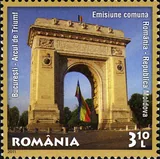
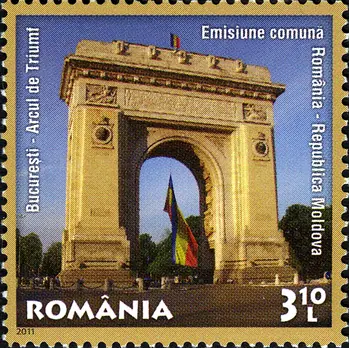
Bucharest's Arcul de Triumf commemorates Romania's First World War soldiers, the union of 1918 and the coronation of Ferdinand and Maria. But the arch you see today was inaugurated in 1936. That gap is a useful starting point: this is a monument to earlier events, built and rebuilt as the country decided how to remember them.
Petre Antonescu designed both the 1922 arch on this site and its permanent replacement. The earlier version had a reinforced concrete frame with a hurriedly finished exterior. The later one gave the ceremony a more durable home, with stone facing, inscriptions and sculpture.
Look at the building as a gateway, then as a surface covered in messages. Its single opening makes the outline easy to recognise. The names, portraits and reliefs make it specifically Romanian. They explain which victories the state wanted people to remember and which royal figures it placed at the centre of that story.
Why an arch appeared here
Temporary triumphal arches had already appeared in Bucharest for nineteenth-century celebrations. Their purpose was partly practical: a procession needed somewhere to pass through. The structure framed an arrival and gave spectators a clear point towards which to look.
The 1922 occasion was the coronation of Ferdinand and Maria as monarchs of Greater Romania. Their coronation took place in Alba Iulia; Bucharest's arch belonged to the celebrations in the capital. The ceremony followed the war and the territorial unions of 1918. Those are connected events, rather than a single victory on a single day.
The present arch followed work in 1935 and 1936. Its inauguration on 1 December 1936 joined the monument to the anniversary of the union. If you know that date, the decision to build it here becomes easier to read: the capital was giving a permanent form to a national commemoration.
Read the names before the whole inscription
From a permitted viewing area, start with a detail you can actually make out. The battle names on the arch refer to places where Romanian troops fought. They turn an abstract claim about victory into a map of particular struggles.
The royal portraits have their own history. Communist authorities removed Ferdinand and Maria's likenesses and royal texts. After 1989, replacement portrait medallions were installed. The faces visible now therefore belong to a restoration of an earlier message, rather than an untouched survival from the inauguration.
That distinction matters when looking at monuments. A building can survive while its official meaning changes. Here, removing a portrait and putting it back were both political acts. The masonry and the changing decoration tell different parts of the story.
A monument in a working city
The arch occupies a traffic junction on Șoseaua Kiseleff. Use pedestrian crossings and designated approaches; the map pin marks the monument, not a safe crossing point or an open entrance. Interior and roof access depend on the operator's current arrangements.
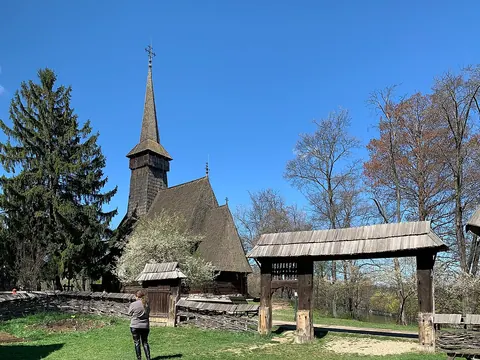
For a useful comparison, pair it with the Village Museum nearby. Both opened in their present institutional forms during 1936, but they present the country differently. The arch concentrates on war, monarchy and national ceremony. The museum gathers the buildings and working spaces of rural households. One asks you to look up at a public statement; the other asks you to examine how people lived.
You do not need to enter the arch to understand its central story. The important sequence is already outside: a celebration in 1922, a permanent monument in 1936, altered royal imagery under communism and its return after 1989.
 EXPLORE THE CITYBucharest city guideRead the city guide ↗
 🏛️
🏛️ 🎼
🎼 ⛪
⛪ 🕊️
🕊️ 🏡
🏡 🏦
🏦 🏛️
🏛️ 🌳
🌳 🏛️
🏛️ 🏛️
🏛️