Find the balcony before looking for the palace
In Bucharest's Revolution Square, a balcony helps explain a change that an enormous building elsewhere in the city cannot. This is where Nicolae Ceaușescu addressed a rally on 21 December 1989 and struggled to control its response. The following day, he and his wife fled by helicopter from the building's roof.
The building was the Communist Party's Central Committee headquarters. It is not the Palace of Parliament. Making that distinction is the most useful first step in reading the square.
The rally was supposed to display support for the regime. Instead, the televised appearance exposed a break between the leader's commands and the people gathered below. The physical arrangement was familiar: one voice elevated above a crowd. What changed was the response.
Look at the relationship between balcony and open space. Then give the surrounding buildings some attention too. The square holds the story of a regime losing power, but also the damage, losses and difficult reconstruction that followed. The helicopter's departure is an important moment, not a complete ending.
A place prepared to display authority
The building now associated with the Interior Ministry had a complicated institutional history before December 1989. The ministry's own account records its completion in 1950 and transfer to the Communist Party's Central Committee in 1958. The party occupied it until the regime's collapse.
An institutional façade can appear impersonal from the street. A balcony changes its relationship with the space in front. Someone can step out of the interior and become the visible focus of a public gathering. Elevation helps direct attention; the square supplies an audience.
On 21 December, Ceaușescu called a rally while events in Timișoara had already challenged the regime. TVR's archive presentation describes an organised gathering of workers brought from Bucharest's factories and other workplaces. The event was intended to show solidarity with the leader and the party.
That context matters because a photograph of a crowd does not tell you why people are there or what choices they have. A staged expression of support is not the same as a voluntary agreement between everyone in the picture. The rally's significance lies partly in the distance between the response its organisers expected and what the broadcast recorded.
The moment the broadcast lost its script
During Ceaușescu's speech, a disturbance rose from the crowd. He stopped and called out "Alo", meaning hello, trying to recover attention. The television transmission was interrupted. The footage and its later retellings have made the moment one of the defining images of Romania's revolution.
You can understand its force without inventing what every person in the square thought or who caused the first sound. A leader accustomed to an organised public response was visibly struggling to restore it. The interruption itself became part of what people understood about the regime's position.
If you later watch the archival sequence, notice the difference between prepared speech and the attempt to respond to something unexpected. A pause can carry information that a long official statement avoids. The balcony still places the speaker above the crowd. It can no longer make the crowd behave as the event requires.
This is where the geography becomes useful. The distance between building and audience, which normally helps compose a display of power, also makes the break in that display visible. The same arrangement can tell a different story when the response changes.
The rally did not turn a whole country from obedience to freedom in a single instant. Events elsewhere, earlier opposition and the actions that followed belong to the larger history. The interrupted speech is a powerful entry point because it lets you see a particular moment when authority's public performance faltered.
The next day brought flight, not an end to danger
Protest and repression continued in the capital after the rally. On 22 December, groups of demonstrators moved towards the centre again. Ceaușescu and his wife left the Central Committee building by helicopter as the regime lost control.
From a visitor's perspective, the escape is an easy place to end the story. It is dramatic, visually clear and gives events a before and an after. The neighbouring institutions preserve reasons to resist that neat ending.
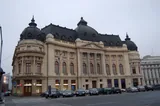
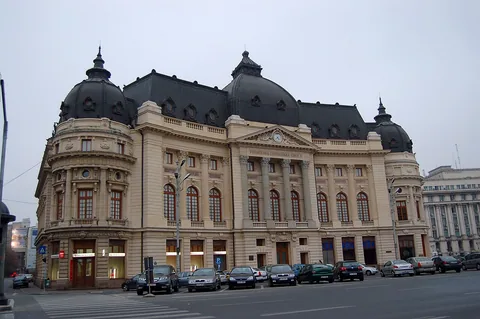
The Central University Library's own history records a devastating fire during the December events. It reports the loss of more than half a million volumes, along with thousands of manuscripts. At the National Museum of Art, housed in the former Royal Palace, the institution records extensive damage to both building and works of art.
These accounts do not identify every cause or settle every contested detail of the violence. They do establish that the collapse of the regime was also a period of destruction. A leader leaving a roof and an institution losing irreplaceable collections are parts of the same city's history.
When you look around the square, allow both to remain present. The memory of liberation does not require you to overlook the uncertainty and losses that accompanied it.
The library shows what a repaired façade cannot return
The Central University Library is a useful place to focus your second look. Its exterior belongs to the architectural ensemble around the square. Its account of December 1989 carries a different kind of scale: books, manuscripts, maps and the years of collecting and use embodied in them.
The library was rebuilt and its collections replenished through donations and exchanges. That is a substantial achievement. It also reveals a distinction that is easy to miss when a building looks whole again.
A damaged room can be restored. Many printed books can be replaced with other copies. A unique manuscript cannot always be recovered that way. Its loss is not cancelled by the arrival of an equal number of volumes.
You do not need to inspect the library's interior to understand that difference. Looking at the repaired building from the square is enough to raise the question. How much of a place's history is visible in its present condition? How much depends on someone preserving an account of what happened there?
The same question applies to the former Royal Palace and its museum. Reopened galleries and repaired architecture are evidence of sustained work after the event. They should not lead you to assume that the collections or the setting passed through 1989 untouched.
Read the square as more than one political era
Revolution Square contains reminders of monarchy, communist rule and the institutions and memorials of later Romania. The former Royal Palace, the library, the party headquarters and the commemorative spaces do not tell an identical story. That is one reason the square rewards careful orientation.
Begin with functions rather than trying to memorise every name. Which building housed royal power? Which became a museum? Which held the party leadership? Which institution stored and shared knowledge? Those questions let you connect the architecture to what people did inside it.
The Interior Ministry's own history also records later changes of use: the former party headquarters accommodated the Senate after 1989, before the ministry returned in 2006. The façade is a relatively stable surface over a changing institutional life.
A memorial introduces another kind of decision. It asks a later public to remember particular people and events in a chosen form. Allow time to read inscriptions where you can do so respectfully and safely. Do not reduce the square to the appearance of one monument, or treat the people commemorated as a supporting detail in a dramatic escape story.
This is an outdoor site with traffic and working institutions around it. Follow public access boundaries and choose a safe place to stop before studying the buildings or reading a longer passage. The guide does not require entering a government building or standing at a precise spot in the roadway.
Look at the balcony again
The balcony is still a useful place to finish. At the beginning of the guide, it marked the place of a famous speech. Now you can relate it to an organised rally, an interrupted broadcast, a flight from the roof and a square whose institutions carried damage into the years that followed.
The architecture did not change between the expected demonstration of support and the moment the broadcast lost its script. The relationship between people and power did.
Then turn your attention away from the balcony. Look towards the library and the former palace. Their repairs, collections and continued uses widen the story beyond one leader. Revolution Square preserves a turning point in public power and the work of living after it. Seeing both gives you a more honest encounter with the place.
 EXPLORE THE CITYBucharest city guideRead the city guide ↗
 🏛️
🏛️ 🎼
🎼 ⛪
⛪ 🕊️
🕊️ 🏡
🏡 🏦
🏦