A concert hall with an unexpected beginning
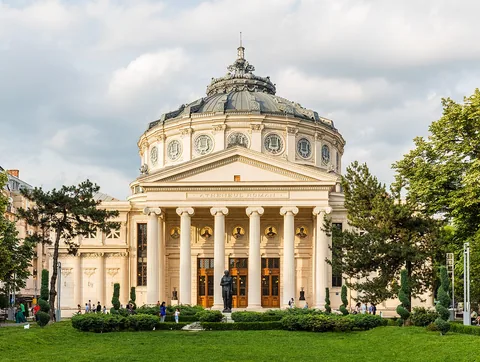
The Romanian Athenaeum looks like a building with a very settled idea of itself. Columns, a triangular pediment and a great dome present culture with the confidence of a classical monument. Yet one of the explanations for its shape begins with a planned riding school.
The Athenaeum was built over foundations already prepared for that earlier project. Its circular form became a strength of the new lecture and concert hall. A practical inheritance helped produce one of Bucharest's most recognisable cultural buildings.
The money has an equally human story. When the Romanian Athenaeum Society could not cover the cost of its ambition, a public lottery helped raise funds. Its memorable appeal was "Dați un leu pentru Ateneu": give a leu for the Athenaeum.
Those two facts offer a useful way into the place. Behind the monumental appearance are adaptations, fundraising and the work of bringing people together. Look for how the building turns that effort into a shared experience, from the entrance outside to the circular room above it.
The public helped build this palace of culture
The Athenaeum Society wanted somewhere for lectures, concerts and cultural life. It was part of the development of modern Romania, when institutions and public buildings helped define what the new state could become.
A cultural ambition still has to meet a construction bill. The lottery gave the project a form people could understand and repeat. The rhyme joined the currency to the building's name; the small unit made the appeal easy to remember.
Public participation helped finance a building whose purpose included bringing culture before an audience. The means of raising money and the intended use were connected.
A concert hall needs that audience as much as it needs a stage. Without listeners, its careful geometry and decoration are only a prepared setting. The Athenaeum's history starts with people being asked to contribute to something they might later enter, hear and share.
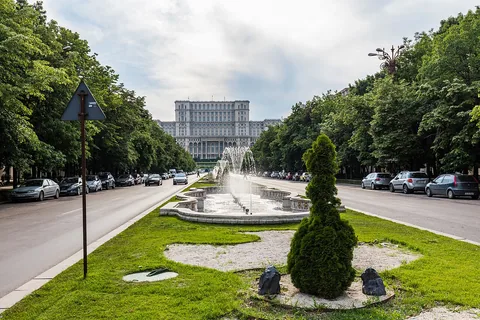
That is a different kind of scale from the Palace of Parliament. Here the story is about gathering people into one room. The impressive exterior is the beginning of that gathering, rather than the whole reason to visit.
Why the room is round
French architect Albert Galleron designed the Athenaeum. The building was inaugurated in 1888, while the completed concert hall became the Philharmonic's home in 1889. Keeping those two moments separate helps explain why different dates can appear in short descriptions.
The circular foundations left by the planned riding school mattered. The new building used a shape that could also suit public speaking and musical performance. The result is a useful example of an architectural constraint becoming an identity.
If interior access is available, notice the relationship between the foyer and the auditorium. The main foyer is beneath the concert hall. The Philharmonic's history explains that limited space influenced this arrangement: the land occupied by the garden did not belong to the society.
This means that approaching the music involves moving upwards through the building. The exterior gives you a dome to recognise; the interior turns its circular organisation into a sequence of spaces. You are passing through a solution to a real site problem, dressed with considerable care.
Look for how the circular lines work with the stairs and columns. You do not need the names of every decorative material to understand what the arrangement does. It gathers movement, separates levels and prepares the transition from arrival to attention.
The façade speaks several cultural languages
From outside, begin with the columns and the triangular form above them. These refer to the visual vocabulary of ancient Greek and Roman monuments. They give the entrance a sense of ceremony before you know anything about the programme inside.
Then notice the portraits in mosaic beneath the portico. They bring Romanian rulers into a façade that also speaks through classical forms and a late-nineteenth-century design. The building's identity is made from those elements together.
This is a useful antidote to the idea that a "national" building must draw everything from a single local tradition. The Athenaeum took part in European architectural and musical conversations while giving them a Romanian setting and purpose.
The European Heritage Label awarded in 2024 recognises that wider significance. It is a distinct designation from UNESCO World Heritage status. The label recognises a site's significance within European history and culture.
The more interesting evidence is already in the building: a society drawing on international design, a public appeal in Romanian, musicians and audiences meeting in Bucharest. Its European connections are part of the story it tells about the country, not an alternative to that story.
History circles the listeners
Inside the auditorium, a painted sequence runs above the boxes. This is Costin Petrescu's great fresco, created in the 1930s. It presents twenty-five scenes from Romanian history.
The placement matters. A visitor might expect a historical painting to hang in a gallery, facing someone who chooses to study it. Here it surrounds an audience assembled for something else. People come to listen, and an account of the nation accompanies their listening.
Treat the fresco as a historical interpretation made at a particular time. Every large history painting selects what to include, what to leave out and how events should relate. A continuous sequence can make the past look like a smooth path, even when the lives and decisions within it were much less tidy.
Choose one scene rather than trying to identify the entire cycle at once. Look for the action, the figures given importance and the way one episode leads towards another. If a label or the Philharmonic's explanation is available, use it to check what you are seeing.
This is not a test of how many names you can remember. It is a chance to see how a building for public culture also creates a public picture of history. Music and painting make different demands on your attention, but they share the room.
George Enescu's name belongs to a living institution
The George Enescu Philharmonic makes the Athenaeum a working place of music. The orchestra's history predates the hall; moving into the completed auditorium in 1889 gave it the home with which it is now closely associated.
Enescu's connection is more substantial than a name on a sign. The Philharmonic records his role in a fundraising campaign for the concert organ. The institution also participates in the festival and competition that carry his name.
If you attend a concert, let the event change how you judge the architecture. A hall that looks impressive in a photograph has another task when it is full of people listening together. Notice the concentration around a quiet passage, the shift when a musical phrase ends, and the way an audience responds to the performers. Those experiences depend on the event you attend; a daytime sightseeing visit cannot promise them.
A good visit can be either kind. One gives you time to inspect the room and its imagery. The other lets you encounter the use for which it is maintained. They reveal different aspects of the same place.
Leave with the circle in mind
Sightseeing access is arranged around rehearsals and performances, so confirm the Philharmonic's current visitor information. The main ceremonial frontage is not a guarantee that it is the entrance used for your visit. Follow the operator's instructions, especially if you need assistance with access.
When you return outside, look at the dome again. Its apparently inevitable shape now has a more interesting explanation: an inherited foundation, a constrained site, a society's ambition and an audience brought together above a foyer.
The Athenaeum rewards that second look. Its grandeur is real, but so are the practical decisions and public efforts behind it. The appeal to give a leu belongs with the columns and the fresco. Together they describe a city making room for culture, and the continuing work of filling that room with life.
 EXPLORE THE CITYBucharest city guideRead the city guide ↗
 🏛️
🏛️ 🎼
🎼 ⛪
⛪ 🕊️
🕊️ 🏡
🏡 🏦
🏦