The palace was built for a bank
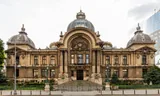
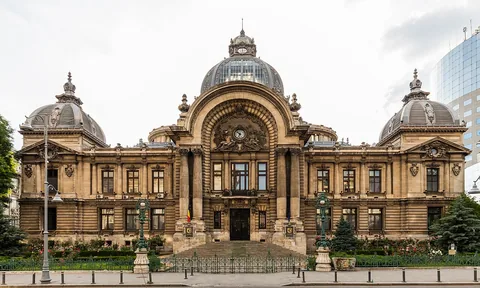
The CEC Palace puts a great arch and a cluster of domes on Bucharest's Calea Victoriei. Carved surfaces and repeated windows make the building look as though an important arrival is expected.
Its client was a financial institution. This was a palace for a bank, rather than a royal residence.
A bank depends on people trusting an organisation with something they cannot simply keep in sight. Architecture can give that organisation a visible address, an appearance of permanence and a place in the city.
The building was completed in 1900 to designs by Paul Gottereau. It belongs to a period when Bucharest's institutions were expressing their ambitions through substantial new architecture. The question here is not just why the bank wanted a beautiful building. It is what that beauty and solidity allow an institution to say about itself.
The institution came before the monument
The savings institution behind CEC dates to 1864, during Alexandru Ioan Cuza's rule. The palace followed decades later. This sequence matters because a striking building can easily become the apparent beginning of an organisation's story.
By the end of the nineteenth century, the institution was able to undertake a new headquarters on Calea Victoriei. CEC Bank's own account dates the building campaign to 1897 to 1900 and identifies Gottereau as its designer.
The same account records that the bank funded construction from its profits. Anghel Saligny contributed through the technical commission. Behind the elaborate façade was an institutional project with financing and engineering oversight as well as an architect.
The foundation ceremony in 1897 was attended by King Carol I and Queen Elisabeta. Their presence connected the commission with the public life of the kingdom, even though the building's purpose was financial.
Think of the building as a later statement about an already established institution. A substantial headquarters can make continuity visible: an organisation that has operated over time presents itself as capable of continuing into the future.
Reading the façade this way helps explain its public role. Its materials and design influence the way a passer-by encounters the institution before learning about its operations.
Begin with the entrance, then find the repetitions
Start at a safe point on the public pavement. Look at the large central arch and the way the façade organises itself around that focus. The entrance is not simply one opening among many. Its framing turns it into an event in the composition.
Then move your attention outwards. Notice repeated windows, the balancing masses at either side and the smaller domed forms that support the central emphasis. The building combines a strong overall order with a great deal to inspect at close range.
You can understand much of the effect without a list of architectural terms. Repetition helps you grasp the building as a whole. Differences draw you towards particular points. The entrance announces where the composition wants your attention, while the details reward the attention once it arrives.
Try one small exercise: follow the outline of the building before studying any carving. Then reverse the process and choose a single sculpted or framed detail. Moving between outline and detail reveals two different kinds of work in the design.
This is especially useful on a street where traffic, people and other façades compete for your eye. The palace has to establish a clear identity at a distance and sustain interest when you get closer.
A French architectural connection in Bucharest
Paul Gottereau was a French architect whose work became part of Romania's institutional landscape. The CEC Palace uses elements associated with French architecture of the late nineteenth century. Its place on Calea Victoriei connects that design language with the development of the Romanian capital.
Bucharest's "Little Paris" nickname can flatten this history if it makes the city sound like a copy of somewhere else. A more useful question is what local clients wanted to accomplish through the designs and expertise they commissioned.
Here, a Romanian financial institution needed a headquarters. International architectural connections helped give that purpose a particular form. The resulting building belongs to Bucharest because of its client, its site and its use, as well as the work that created it.
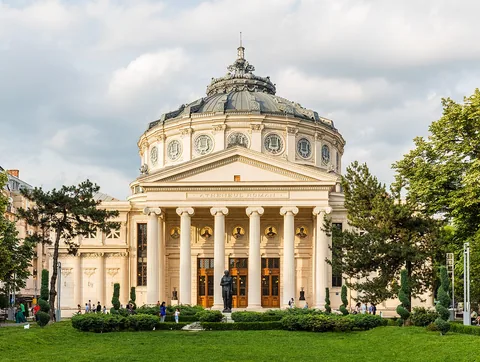
Nearby, the Romanian Athenaeum offers another example of international design adapted to a different institutional ambition. There the story concerns a cultural society, fundraising and a concert audience. At CEC Palace it concerns finance and an institutional address. Similar visual confidence can support different kinds of public life.
The street gives the palace its audience
Calea Victoriei is part of the experience. The palace is not an isolated object waiting to be appreciated from every direction at once. It addresses a street, and your view changes as you approach, pass and look back.
The site itself had an earlier religious use: the municipality records the old church of Saint John the Great here before the palace. Calea Victoriei's institutional buildings occupy ground with histories beneath their present façades.
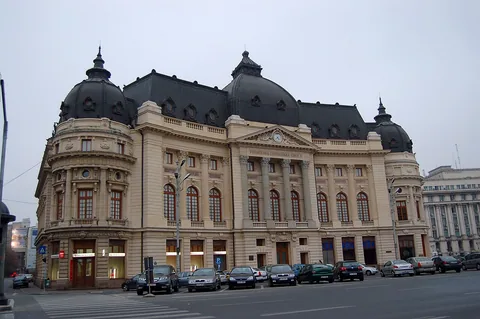
The National Museum of Romanian History stands across the street in the former postal palace. Even without entering either building, you can compare how large institutions make themselves recognisable in an urban setting. Entrances, windows and the relationship to the pavement help you read their public presence.
Do not assume that similar scale means identical access. A museum, a financial institution and a concert hall have different responsibilities and different ways of receiving people. An impressive entrance is not a general invitation to explore every room behind it.
For this guide, the exterior provides the main encounter. Check directly with the institution if you want to attend a specific event or visit an interior. Do not plan on unrestricted sightseeing access merely because the building appears on tourist maps.
You can still get substantial value from the street. Look for the point where the central arch is clearest, then notice how the dome relates to the roofline of the buildings around it. Choose viewpoints on public pavements and crossings, rather than stepping into traffic for a symmetrical photograph.
A visible address for an invisible promise
Return to the fact that began the guide: this palace was built for a bank.
The façade's elaborate confidence now has a purpose you can consider. A financial institution deals in obligations, records and promises that are not all visible to the person outside. A headquarters gives those activities a physical presence.
The building's longevity adds another layer. It has remained recognisable while the city and the institution around it have changed. That continuity makes it an effective landmark, but its history is still more than a story of an unchanging façade.
Look once more at the entrance. You can appreciate the design and also recognise the work it does: directing attention, expressing permanence and establishing an institutional place on Calea Victoriei. That is why the palace is worth more than a quick photograph on the way to somewhere else.
 EXPLORE THE CITYBucharest city guideRead the city guide ↗
 🏛️
🏛️ 🎼
🎼 ⛪
⛪ 🕊️
🕊️ 🏡
🏡 🏦
🏦