The missing inn is the beginning of the story
Stavropoleos is a small church with enough carved and painted detail to hold your attention for a long time. In Bucharest's Old Town, it is easy to approach it as a beautiful pause between larger sights. Its history offers a better reason to stop: this place of prayer was supported by an inn.
The founder, the Greek monk Ioanichie, established the monastery in 1724. He had first created an inn for travellers and merchants. Its income helped sustain the religious community and the work around it.
The original inn has gone. The church survived, and later restoration gave the courtyard its surrounding arcades. The church and its surroundings therefore belong to different periods.
As you look, keep two questions in mind. How did a working part of the commercial city support a monastery? And how did a vulnerable small church become a place that also preserves fragments of other buildings Bucharest lost?
Trade and prayer shared the same enclosure
An inn was a practical response to a city receiving people and goods. Travellers needed lodging; merchants needed somewhere to stay while conducting their business. At Stavropoleos, that activity also helped provide resources for worship.
Ioanichie's foundation grew beyond the income of one building. The monastery's history records properties and gifts that supported its work. It also describes assistance to a school, to the founder's earlier monastery in Epirus and to people in need.
You do not have to imagine the religious and commercial worlds as opposites to understand this arrangement. Buildings, income and charitable obligations connected them. The church was part of the life of the city around it, not an escape from the need to organise and pay for that life.
Think of the missing inn as the first invisible feature of your visit. A photograph can show you the church that remains. Knowing about the lodging around it restores a different scale of activity to the scene: arrivals, business, the movement of strangers through the capital.
The building's small size becomes more interesting in that context. Its purpose was to serve a particular community within a working enclosure. It was not designed to dominate a great ceremonial avenue.
Let one carved detail slow you down
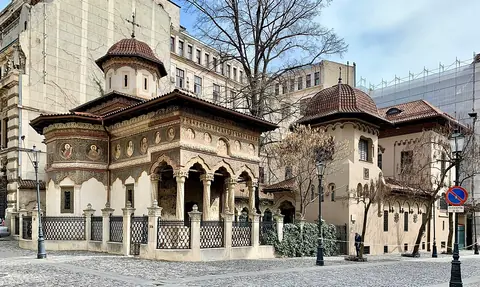
The church belongs to the post-Brâncovenesc tradition. That label becomes useful when it directs your attention to something you can see: the porch, the columns, the stone carving around openings and the painted surfaces.
Start with one column or an edge around the entrance. Follow the design slowly. Notice how a repeating pattern has to respond to a corner, a curve or a change of surface. Decoration becomes easier to read when you see how it is made to fit a real building.
Then step back, if there is room, and compare the scale of the detail with the scale of the church. The effect comes from attention concentrated on a compact structure. You can move between the whole and its parts without needing the distant viewpoint that a much larger monument demands.
Inside, if visiting is permitted, allow your eyes time to adjust. Painted figures and the iconostasis belong to an Orthodox place of worship. The iconostasis is the screen carrying icons between the main space used by worshippers and the sanctuary. Its religious purpose is more important than treating it as a decorative backdrop.
You do not need to identify every saint or every carved motif to make a worthwhile visit. Looking carefully, staying aware of worship and choosing one question to follow will give you more than rushing to collect a complete visual inventory.
The courtyard is also a work of restoration
The peaceful-looking enclosure can make the ensemble seem as if it has always stood this way. It has not. The old inn deteriorated and was demolished, leaving the church as the principal surviving part of the original foundation.
Architect Ion Mincu's restoration project shaped the later enclosure with its columns and arcades. The monastery's account describes an extensive campaign beginning in 1904. The church was strengthened, and a tower lost after an earlier earthquake was rebuilt.
This changes what you are looking at. The courtyard is not simply an untouched eighteenth-century setting. It is also evidence of a later decision to care for the church and give the site a renewed architectural frame.
Restoration is often easiest to overlook when it succeeds in making a place feel coherent. Here, try to recognise two achievements: the earlier building that endured and the later work that helped it continue. Neither becomes less valuable because the other exists.
The same principle applies to the present condition of the paint, stone and wood. Survival over centuries is rarely passive. It depends on maintenance, repairs, decisions about what to preserve and people prepared to do that work.
Stones from other buildings found a place here
Under the courtyard portico is a lapidarium: a collection of worked stone. The monastery describes gravestones, inscriptions, columns, capitals and sculptural fragments assembled here. Some came from churches and monasteries in the old centre that had fallen into ruin or were lost during the city's earlier modernisation.
A fragment asks you to look differently from a complete building. A carved capital once occupied a precise position and performed a particular visual job. Removed from that setting, it can preserve skill and an inscription while leaving much of the surrounding story incomplete.
You can make that incompleteness part of the visit. Look for the form of an edge or the way a letter is cut. Ask what information survives in the stone, and what would require a label, an archive or a plan to recover. Avoid assuming that every piece in the courtyard came from the communist demolitions; the history of this collection reaches into earlier losses.
The monastery also has a separate collection of church art that commemorates buildings demolished under communism. Its own description identifies fresco fragments from the Enei Church and Văcărești Monastery among the works preserved. Check current access before expecting to see the indoor collection.
Together, the courtyard and collection make Stavropoleos a particularly revealing Old Town stop. One surviving church has become a place where traces of other sacred buildings are kept. It carries more of Bucharest than its small footprint suggests.
A monastery living in the present
Stavropoleos became a monastery with a community of nuns again in 2008. Its religious and cultural life includes conservation, books and church art. The monastery's heritage account describes a library containing theological, historical and artistic works, as well as older books and musical manuscripts.
These activities belong with the church rather than sitting outside its history. A manuscript survives because someone stores it, studies it and decides it is worth keeping. A carved surface remains legible because someone notices when it needs care. A community continues because people give time to it in the present.
For visitors, that means adjusting to a place that has purposes beyond receiving visitors. Keep your voice low, follow posted directions and let services and the community's work determine what access is possible. A room described on a website is not necessarily open at the moment you arrive.
Before you leave, look once more at the church and the arcades around it. You can now place them in a longer sequence: an inn supporting prayer, a surviving church after the inn's loss, a restoration that formed a new enclosure, and a community preserving both its own inheritance and fragments of the city around it.
The inn is absent from the photograph. It no longer has to be absent from your understanding of the place.
 EXPLORE THE CITYBucharest city guideRead the city guide ↗
 🏛️
🏛️ 🎼
🎼 ⛪
⛪ 🕊️
🕊️ 🏡
🏡 🏦
🏦