One address, several different visits
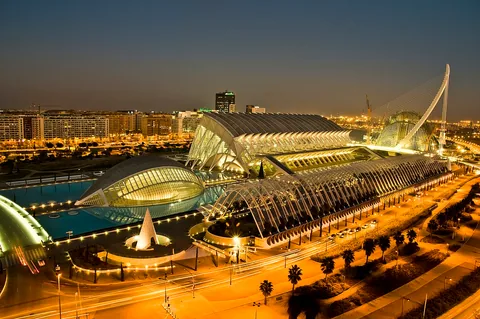
Valencia's City of Arts and Sciences is a group of cultural and scientific venues along the old Turia riverbed. Its distinctive buildings make a strong shared image, but they contain different experiences. A cinema screening, a science museum visit and an opera performance are not interchangeable parts of one room.
The architecture helps establish those identities. The Hemisfèric has a low, rounded profile, while the Science Museum extends in a long sequence of repeated structural forms. The Umbracle adds a garden promenade, and the Oceanogràfic occupies its own aquarium setting.
Begin by choosing whether you want to look at the architecture or enter a particular venue. Both are valid ways to understand the complex, but they require different amounts of time and different admission plans.
Separate the architects as well as the buildings
Santiago Calatrava designed the Hemisfèric, Science Museum, Umbracle, Palau de les Arts and Àgora. Félix Candela's contribution includes the distinctive roofs of the main Oceanogràfic buildings. Giving every form to one architect would hide an important difference within the ensemble.
Look at the way a roof meets the space below it. A broad enclosure for performances has different demands from a long museum or an open garden structure. The buildings share a setting without needing to share the same outline.
In a view across the pools, reflections can make those outlines seem larger or more symmetrical. Compare the actual structure with its reflected image. That is a useful way to slow down an architectural photograph and recognise what is building, water and open space.
The spaces between are part of the visit
The complex occupies a long section of the former river corridor rather than a compact old-town square. Moving between its buildings is part of understanding their scale. A destination that appears beside another on the map can still require time to reach its actual entrance.
The Umbracle introduces planted space among the large cultural buildings. The Palau de les Arts serves opera and other performances, while the Àgora houses CaixaForum's cultural programme. Those different uses help explain why the site is a collection of destinations rather than a single museum with an unusual roof.
Before booking, check the venue you actually want, its current programme and its entrance instructions. This written guide includes no tickets and does not promise access to every building. For an exterior visit, use the public paths and compare two neighbouring forms. The architecture becomes more readable once each shape belongs to a particular activity.