Look above the stalls
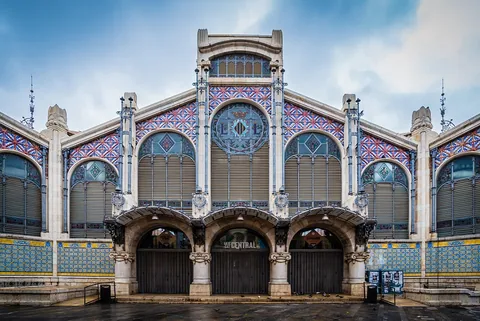
Valencia's Central Market opened in 1928, but people had traded on this site long before the present building. Its iron, glass and ceramic decoration gave an established urban activity a new setting. The market remains a place to buy food, so the people working and shopping here are part of its purpose.
The dome is a useful starting point. Light enters above the stalls while straight aisles organise movement below. Decorative fruit, colour and the weather vanes connect the architecture with the goods the building was made to sell.
Pause somewhere that leaves the aisle clear and look upwards. The market's story sits partly above eye level, beyond the products that naturally attract attention first.
A new building took more than one decision
An uncovered market opened here in 1839. By the end of that century it no longer met the city's needs. Valencia's municipality held competitions for a replacement, selecting the proposal by Alejandro Soler March and Francisco Guardia Vial in 1910.
The chosen design was revised before construction. Enrique Viedma and Ángel Romaní eventually brought the work to completion. Remembering that sequence avoids treating the opening date as the moment when someone first imagined the market.
Its materials belong to a city investing in a modern commercial building. Iron could support large covered spaces, while glazing brought light into them. Ceramics and patterned surfaces gave the practical structure a recognisably Valencian decorative character.
The plan makes the room work
Follow the direction of an aisle before looking at an individual stall. The operator's historical account describes a grid crossed by two broad passages. Shopping needs that organisation: people have to find a counter, move between sections and carry purchases out again.
The market's decoration also makes distinctions overhead. A parrot and a fish appear as weather vanes above different parts of the building. The roof is not simply a lid over the trading floor; it helps give parts of the market their own identities.
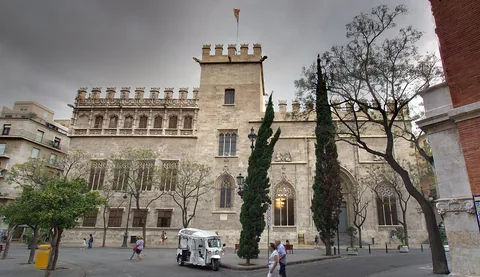
Across the square, La Lonja offers a useful comparison. Its Gothic trading hall gave contracts and commercial institutions a formal setting. Here, a twentieth-century building accommodates the repeated work of selling food. The subjects are connected without being interchangeable.
Check the market's own information before travelling for a particular stall or opening time. During a visit, let buying and selling take priority over the photograph you want. A clear look at the dome and a short stretch of aisle can explain the building while leaving room for the people it serves.