A prayer hall that became a museum
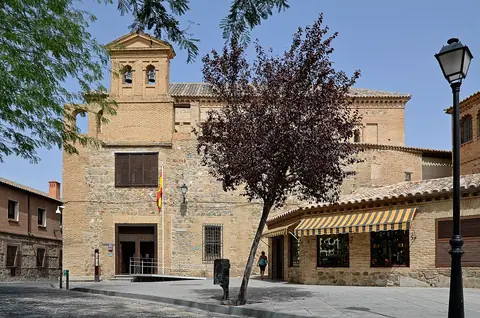
El Tránsito Synagogue in Toledo, Spain, was commissioned in the fourteenth century by Samuel ha-Leví, a senior official and treasurer at the court of Pedro I of Castile. Its great prayer hall survives within the Museo Sefardí, the Sephardic Museum.
The hall combines a high timber roof with elaborate plasterwork and inscriptions in Hebrew and Arabic. Those words are part of its religious and historical identity. The building used artistic forms found elsewhere in medieval Iberia, but it was made for Jewish prayer and study.
Its later name comes from a Christian phase. After the expulsion of Jews in 1492, the synagogue passed to the Order of Calatrava and became a church. The present museum asks visitors to recover the Jewish history within a building altered for other purposes.
Look up, then read the walls
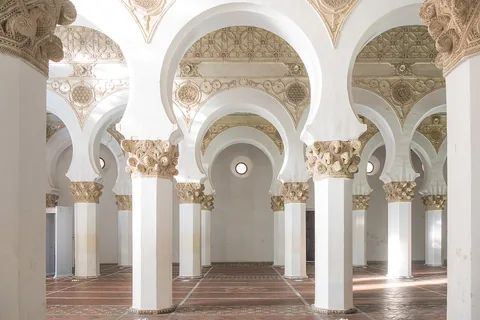
The timber roof spans the great hall without the repeated arcades that dominate nearby Santa María la Blanca. That difference makes the two synagogues worth comparing. Here the large room brings your attention to the upper walls and the structure over your head.
The plasterwork includes bands of writing among the ornament. Hebrew inscriptions refer to prayer, the Torah and biblical models of sacred building. Arabic writing appears too. Their presence shows an artistic and linguistic setting with several traditions, while the content helps identify the hall's particular religious use.
You do not need to read either language to notice the distinction between a written band and a decorative pattern. Let that be a starting point rather than assuming every surface is abstract ornament. Some of the most important things in the room were intended to be read.
From a lost congregation to a public collection
Conversion changed the hall. An altar was installed in the area of the former Torah ark, and other parts of the complex acquired new uses. Those alterations followed the expulsion of the community, not a simple agreement to exchange religious functions.
Later restoration also shaped what visitors see. The present room is the result of preservation and choices about which elements to reveal, rather than an untouched fourteenth-century interior. The Sephardic Museum opened to the public in 1971 after years of planning and work on the building.
Its collections widen the subject beyond the former synagogue, explaining Hispano-Jewish life and the Sephardic diaspora. The monument is therefore both a place to examine architecture and a setting for learning about people whose history continued elsewhere. Look back at the hall with that in mind: the surviving roof and words provide evidence, but they are only part of the human story.