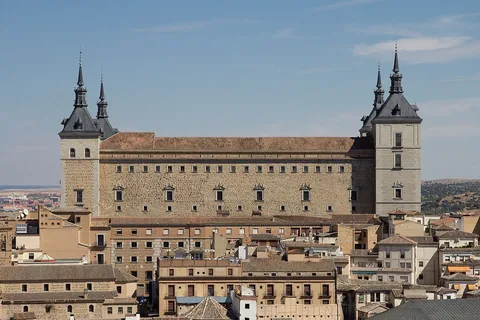
The large block above the roofs
The Alcázar stands on high ground in Toledo, Spain. Its broad rectangular form and four corner towers make it one of the easiest buildings to recognise above the old city's roofs. The site has a much older defensive history, but the palace form owes a great deal to rebuilding under the sixteenth-century rulers Charles V and Philip II.
It also owes much to reconstruction. Fires damaged the building, and the siege of 1936 during the Spanish Civil War left it in ruins. The present exterior should not be mistaken for an untouched Renaissance or medieval fortress.
The Army Museum now uses the building, while the upper part also houses the regional library. The Alcázar has remained a prominent place in Toledo by changing its function and being rebuilt, rather than simply surviving without alteration.
A palace on a fortress site
The hilltop position explains why rulers repeatedly wanted to use the site. A conspicuous building could control views and make royal authority visible within the city. Yet the large palace that developed here needed spaces for ceremony and household life as well as walls and towers.
Architects including Alonso de Covarrubias and Juan de Herrera worked on its Renaissance development. The regular arrangement of its fronts and corner towers offers a useful contrast with the smaller, less uniform roofs below. From a public viewpoint, you can see the difference in scale without entering the museum.
Inside, the imperial staircase provides a more detailed example. It was rebuilt after the Civil War following the Renaissance design, incorporating original granite steps. An element can therefore contain both old material and later reconstruction. Calling it simply original or modern would miss how the work was done.
Looking at evidence of destruction
The museum's history of the building includes the siege of 1936 and reconstruction after 1940. Photographs and models can help bridge the gap between the familiar skyline and the damaged structure from which it was rebuilt. They show why the present outline cannot tell the whole story by itself.
The Alcázar also contains evidence of less dramatic practical needs. Water storage, former stables and service passages supported life within the complex. Those spaces widen the subject beyond royal fronts and military events.
You do not need to treat a visit as an obligation to see every collection. The building is one subject; the museum's military history is another, much larger one. Check current access to historic spaces before planning around a particular room. From outside, keep the reconstruction in mind when the corner towers reappear above the streets: a stable-looking city landmark can have a history of repeated loss.