A large church with several centres
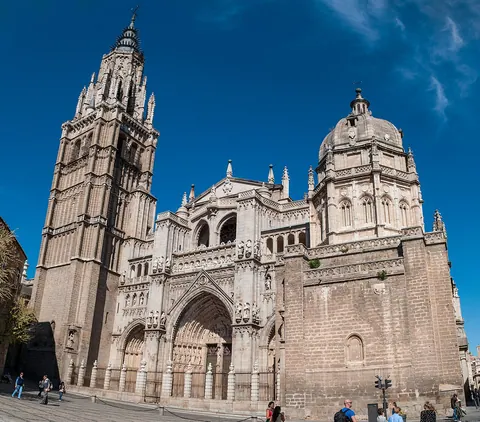
Toledo Cathedral in Spain began its present Gothic building campaign in 1226, under King Fernando III and Archbishop Rodrigo Jiménez de Rada. Its broad plan has a central nave with four side aisles, a crossing and a passage around the main chapel. It was made for movement and worship on a scale quite different from Toledo's smaller religious buildings.
Inside, the main altar is not the only place with a job to do. The choir, sacristy, chapter house and cloister supported different parts of the cathedral's religious and institutional life. Many contain work added long after the medieval structure was established.
One particularly clear later intervention is El Transparente, completed in 1732. Narciso Tomé opened the vault to bring light towards the tabernacle and made sculpture part of that new opening. A Gothic building could still be changed substantially for worship centuries later.
Read the plan before the collection
The cathedral contains enough art to overwhelm a first visit. Begin with the organisation of its spaces. Repeated supports divide the long interior, while the passage around the head of the church lets movement continue beside the main chapel.
The choir marks a different centre within the larger church. It provided the clergy with a place for the sung services that ordered their day. Carved seating therefore belongs to a working arrangement as well as to the history of sculpture.
The chapter house supported the cathedral's governing community, and the sacristy served its ceremonial needs. Their decoration can be admired without losing sight of those functions. A cathedral needed people, records and preparation as well as a great space for public worship.
A hole made into a design
El Transparente is behind the high altar, in the ambulatory. Its mixture of marble, sculpture and light can appear very different from the surrounding Gothic masonry. The opening above it was a deliberate solution to a particular religious aim: directing light towards the place where the consecrated sacrament was reserved.
Rather than trying to identify every figure at once, compare the direction of the light with the surfaces it catches. The effect depends on the opening and the building around it, not only on individual sculptures. It is an alteration that asks you to look upward and back towards the altar.
The cathedral remains a church in daily use. Some spaces have visitor access and others serve internal purposes, so follow the current route rather than assuming the whole complex is open. From outside, its tall tower gives a useful city landmark. Inside, the different spaces explain how that landmark has continued to function.