A date written into the facade
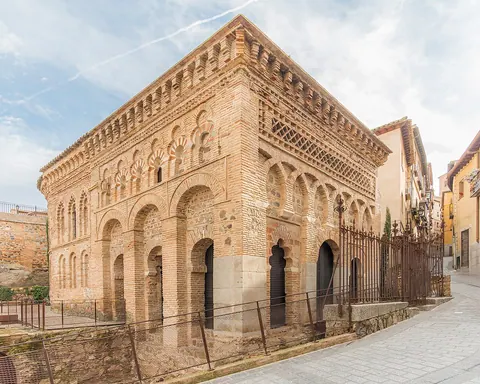
Cristo de la Luz in Toledo, Spain, began as the mosque of Bab al-Mardum. An inscription on its brick facade dates the building to 999. Its small square hall contains four central columns that divide the interior into nine vaulted bays.
The name Cristo de la Luz belongs to its later Christian history. After Toledo came under Christian rule, the building was adapted as a church and an apse was added in the twelfth century. You can read those phases together without treating them as one original design.
Begin with the compact square structure, then look for the extension. Inside, if access permits, compare the different vaults overhead. A building that seems small from the street contains an unusually varied set of ways to cover a room.
A square divided into nine
Four columns create a three-by-three arrangement of bays. That simple plan lets a visitor recognise the building's organisation quickly, but the ceiling prevents it from feeling mechanically repeated. The vaults have different patterns, with the central part rising above the surrounding ones.
Some supports and capitals were reused from earlier buildings. Reuse here was part of construction, not an accidental later intrusion. It linked a new place of worship with available materials that already had a history in Toledo.
Outside, the brick arcades and geometric patterns give the walls their character. The inscription was hidden by a later wall until its rediscovery in the nineteenth century. Its visibility today reminds us that even a construction date can disappear from view and then return through investigation of the building.
The added apse and the later story
The Christian apse changed the space required for worship. Its presence makes the later use visible in the plan instead of merely giving the mosque a new name. The building now records both religious phases in its fabric.
A local legend connects the place with Alfonso VI and a kneeling horse that revealed a hidden crucifix and a burning lamp. It explains an attachment to the monument, but it is a tradition, not evidence for how the mosque was constructed or converted. The inscription and architectural additions provide a different kind of historical information.
Toledo is often described through three religious cultures. This small building makes a useful correction to an overly simple version of that phrase: uses succeeded one another, and authority changed. Shared space across time did not always mean shared worship at the same moment. Look once more at the square hall and its extension, and the sequence becomes visible.