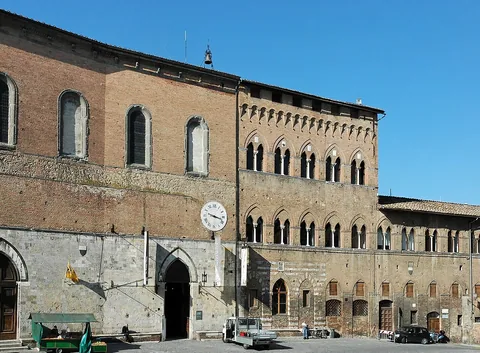
The building facing the cathedral cared for people
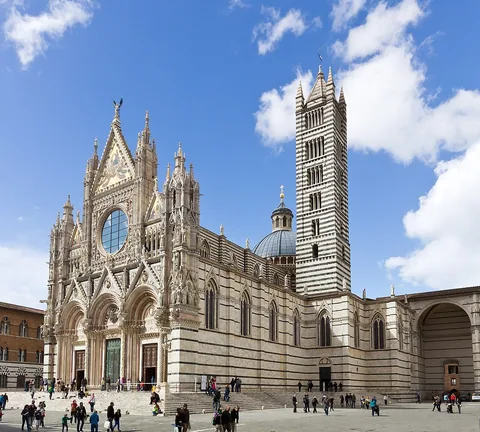
Across from Siena Cathedral stands Santa Maria della Scala, a former hospital that now contains a museum complex. Its religious name can suggest another church, but its history includes shelter, medical care and assistance. The large Pellegrinaio, or pilgrims' hall, gives that work a visible setting.
Paintings in the hall show the hospital's own idea of its activities and importance. They are useful evidence, but they were commissioned to represent the institution, not to record every patient's experience without judgement. If you visit inside, compare the painted scenes with the size and arrangement of the room holding them. The relationship between care and self-presentation is what makes this former hospital different from an ordinary gallery.
A hospital had to make more space
In 1328 the hospital expanded its men's pilgrims' accommodation by acquiring and demolishing surrounding houses. The work crossed a substantial change in ground level. Santa Maria della Scala grew through the difficult topography of Siena, rather than occupying one simple flat plot.
The present complex extends over several levels. Its internal road and connecting spaces helped organise movement between different parts of the institution. A facade seen from the cathedral square cannot explain all that lies behind and below it.
That is a useful first adjustment when you enter. Think of a working collection of spaces for different activities, changed through time. The museum route now makes parts of that accumulated structure accessible, but its form began with the requirements of an institution that needed room to operate.
Care becomes an image of the institution
The Pellegrinaio received a major decorative programme in the 1440s. The hospital community commissioned artists including Domenico di Bartolo, Vecchietta and Priamo della Quercia. Scenes connected the institution's history with its acts of assistance.
Among them are care of the sick, the distribution of alms and support for poor young women. Look for the actions within a scene: who gives, who receives, and how the painter makes their relationship understandable.
The paintings can tell us what the hospital wished to celebrate. They do not allow an automatic conclusion that every person received the care shown or that assistance involved no conditions. Read them as public claims made through skilled art. That leaves room both for the practical work and for the authority the institution wanted that work to confer.
A museum preserves pieces of the wider city
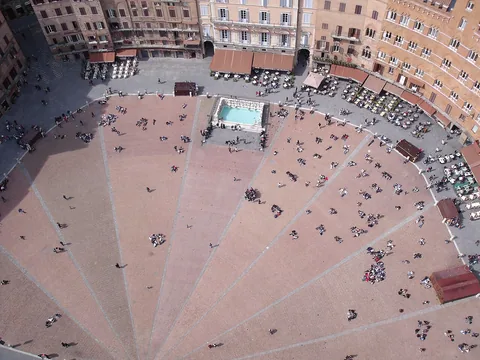
Santa Maria della Scala also holds surviving original marbles from Jacopo della Quercia's Fonte Gaia. The fountain visible in the Campo is a nineteenth-century replacement. Original fragments, models and casts let the museum explain what the outdoor monument can no longer show directly.
This adds another purpose to the former hospital. Rooms once used for assistance now help preserve and interpret objects from elsewhere in Siena. A city building can continue to serve public needs after the original institution changes.
Check the museum's current access information if you want a particular room or collection. This guide does not include admission. Even from the square, the position opposite the cathedral offers a useful pairing: religious worship on one side and the long organisation of care on the other.