Let the slope explain the square
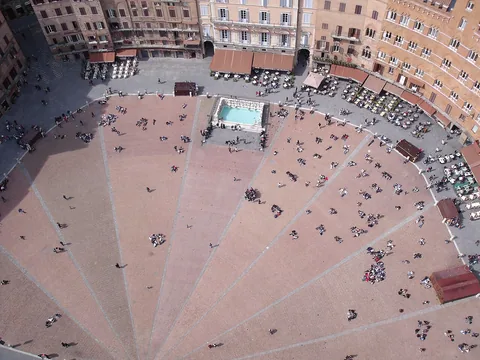
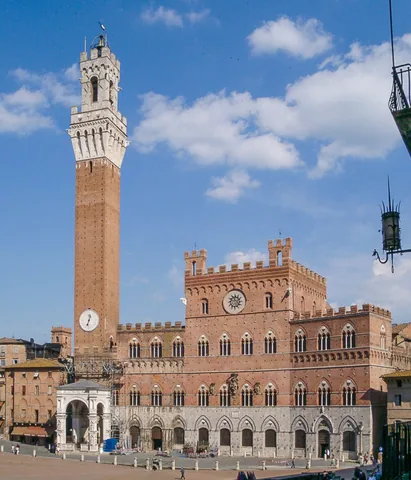
Piazza del Campo slopes towards Palazzo Pubblico, Siena's town hall. Pale bands divide the brick paving into nine fan-shaped sections. The whole space turns your attention towards government, but it was also made for markets, gatherings and public events.
The square's coherence was not an accident of buildings arriving one by one. Medieval regulations controlled the appearance of the fronts facing it. That helps explain why a large, irregularly enclosed place can feel like one designed room. Start by following a paving band towards the lower edge, then look back across the surrounding facades. You are seeing both a useful gathering space and a deliberate presentation of the city to its own inhabitants.
Look at the houses as a group
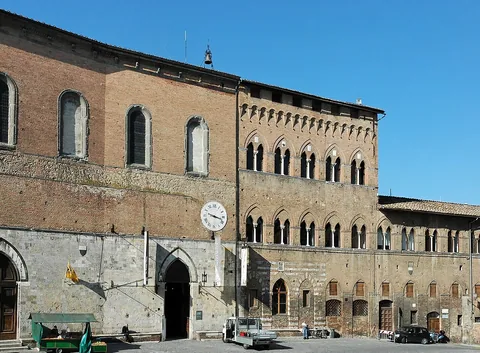
The municipality laid down regulations in 1297 for the buildings facing the square, including rules about their windows. The fronts belonged to different properties, but their owners did not have complete freedom over the public view.
That relationship remains useful to notice. Compare the individual entrances and rooflines with the repeated window forms. The buildings have their own identities while contributing to a larger enclosure.
The square is also where several approaches to the city centre meet. The streets deliver you into a space much wider than themselves. You do not need to imagine the Campo empty in order to understand its shape. Ordinary use is part of the reason it was made so large.
Nine sections and a shared arena
The nine paving sections are associated with the Government of the Nine, which held power from 1287 to 1355. Their visual direction towards Palazzo Pubblico connects that political history with something directly under your feet.
The Campo also becomes the setting for the Palio horse race. During the event, the outer track receives a covering of tuff. What looks like a continuous paved public space in ordinary conditions becomes divided by the requirements of a particular civic ritual.
That change is worth understanding without assuming a race will take place during your visit. Temporary arrangements can alter access, views and movement. The everyday square and the event space are two uses of the same inherited form, rather than two different places.
A fountain with an original elsewhere
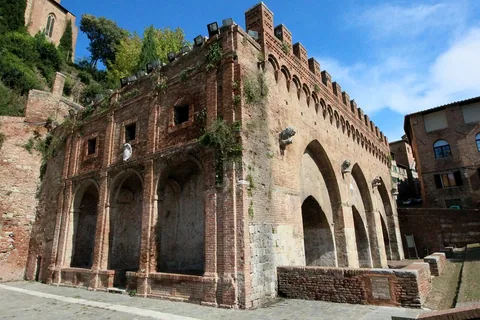
Fonte Gaia occupies the upper part of the square. The visible sculpture is Tito Sarrocchi's nineteenth-century replacement for Jacopo della Quercia's early fifteenth-century fountain. The original marbles survive at Santa Maria della Scala.
The distinction matters because the Campo can give a strong impression of one preserved medieval scene. Some of what creates that impression is later conservation work. A copy can keep an important civic image in the square while the more vulnerable original is protected elsewhere.
Before leaving, compare the fountain's position with the lower edge of the paving. Water, slope, public gathering and the facade of government all have a place within the same space. Its famous outline becomes more useful once you can see how those parts work together.