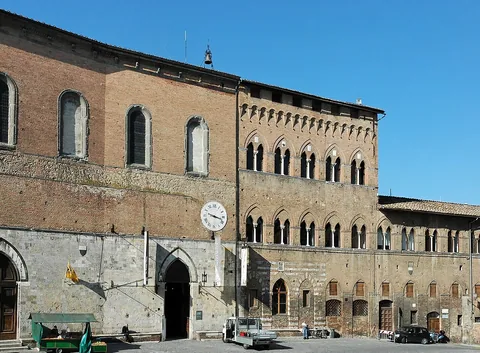
A palace built for a government
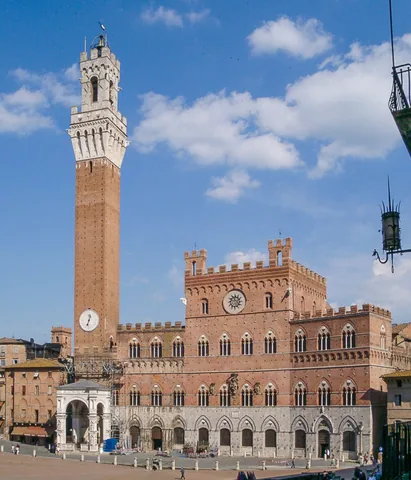
Palazzo Pubblico stands at the low side of Siena's Campo, with the Torre del Mangia rising beside it. Despite the word palace, this was a seat of civic government. The Government of the Nine commissioned the building around the turn of the fourteenth century.
Its strongest connection between art and use lies inside. Ambrogio Lorenzetti's paintings about government decorated a room where the Nine actually worked. Images of justice and civic order therefore faced people making decisions, rather than hanging in a gallery created centuries later. Start with the facade and its public position. If access permits an interior visit, carry that relationship with you: these rooms once helped government present itself and reflect on what governing should achieve.
The facade speaks to the square
The lower stonework and upper brick storeys give the building a clear material structure. Pointed windows repeat across the front, while the taller central section and battlements distinguish it from the surrounding houses.
Its symbols belong to more than one period. The facade includes civic arms, a Christogram associated with Bernardino of Siena and a Medici coat of arms added after Florentine domination. They should not all be read as one unchanged statement from the first builders.
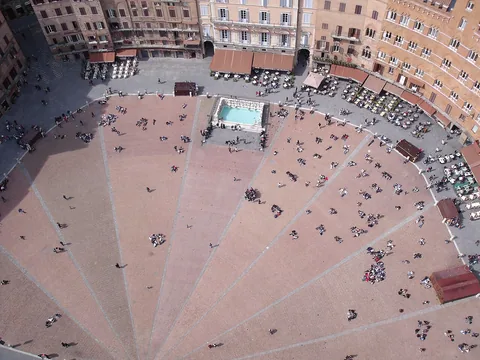
Look at how the palace addresses the Campo. The square provides a broad public audience for the building, while the building gives the square a political focus. This relationship is easier to grasp from outside than from a list of rooms or officeholders.
Justice has to reach the citizens
Lorenzetti painted the Allegory of Good Government in 1338 and 1339. In its composition, Justice, Concord and a procession of citizens connect with a central figure representing Siena. Personified virtues surround civic authority.
One useful detail is the cord held by the citizens. It links a group of people with the order represented above them. The painting gives an abstract political idea something visible to follow.
This is a programme made for government, so it also presents an idealised view of what its patrons claimed to pursue. The images should not be treated as proof that every citizen enjoyed equal power or that the city's rulers always met their own standards. Their value lies partly in the gap between a stated ideal and the decisions made beneath it.
Separate the courtyard, museum and tower
The Courtyard of the Podestà, often called the Entrone, offers another scale after the public facade. Coats of arms and the surrounding arches mark an interior civic space with several connections beyond it.
The museum and the Torre del Mangia are related to the palace, but access to one should not be assumed to include every other space. Check current arrangements if your visit depends on a particular room or a climb.
You can still understand the basic relationship from the Campo. The tall tower announces the municipality above the roofs. The lower palace holds the rooms where civic authority operated. Inside, paintings turned that authority into a subject to examine.