Start with the roof
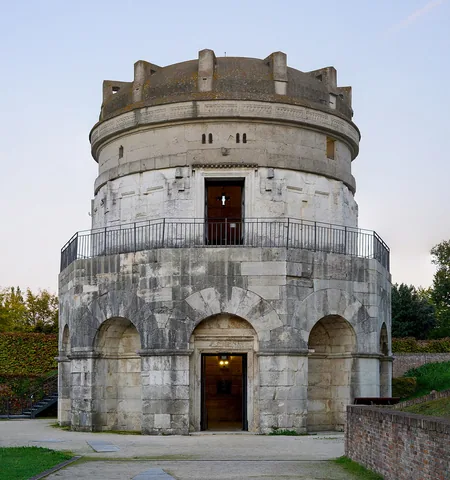
Theodoric's mausoleum stands beyond the railway northeast of central Ravenna. It looks different from the city's brick churches because it was built from large pale stone blocks. Above its two levels sits the feature that explains much of its fame: a domed roof carved from a single stone.
The Ostrogothic king commissioned the tomb around 520. The enormous roof prompts an obvious engineering question: how did workers transport it and put it in place? Several explanations have been proposed, and the building does not provide a complete record of the operation. Begin with what you can inspect, the stone, the joints and the relation of roof to walls. Its achievement remains remarkable without pretending every construction question has been settled.
A royal tomb made from weight
The two stacked storeys use a decagonal outer form. Deep lower openings and the heavy mass above them make the building's structure unusually legible. You can compare the wall blocks with the single piece resting over the upper chamber.
Projecting features around the roof are often discussed in connection with lifting and transport. Their presence is visible; their precise role in construction is a matter of interpretation. That distinction is worth retaining when an attractive explanation sounds too complete.
The mausoleum also gives a different impression of royal ambition from a mosaic portrait. Here, the commission declares its expense through difficult material and construction. The ruler's memorial takes the form of something that appears exceptionally hard to move or dismantle.
Two levels do not tell the same story
The lower chamber has a cross-shaped plan. The upper chamber is more centrally organised and contains a porphyry basin traditionally associated with the king's burial.
If access allows you to visit the chambers, compare them with the outer shell. The external decagon does not mean that both inner rooms repeat the same outline. The relationship between a building's outside and inside needs checking rather than assuming.
The red-purple porphyry object is another point where a familiar material carries royal associations, but its surviving presence does not mean the king remains inside. The official account records the loss of his remains following the mausoleum's later conversion to an oratory. The tomb outlasted the burial arrangement it was intended to protect.
Keep the crack and the legend separate
A crack in the roof has attracted a story in which divine lightning killed Theodoric as punishment. That is a legend attached to a visible feature, not a documented explanation of the king's death or a structural investigation.
The crack is worth looking for because it belongs to the actual stone. The story is worth knowing because later people used the building to judge the ruler remembered there. They are different kinds of evidence. Before leaving, look once more at the whole roof and the smaller blocks below. The contrast makes the scale of the original task easier to grasp.