The image explains the room
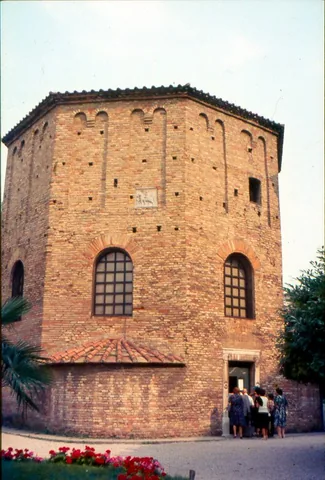
Ravenna's Neonian Baptistery stands beside the cathedral. Its most useful connection is simple: the basin below served baptism, and the mosaic at the centre of the dome shows the baptism of Christ. The room surrounds the ceremony with an image of the event that gives it meaning.
The octagonal brick building began in the early fifth century. Bishop Neon later commissioned the decoration that gave it its familiar name. It is also called the Orthodox Baptistery, distinguishing it from the city's separate Arian Baptistery. If you can see the interior, start with the centre of the ceiling and then follow the circular bands around it. The decoration is easier to read when you know what the building was for.
A low building with a longer history
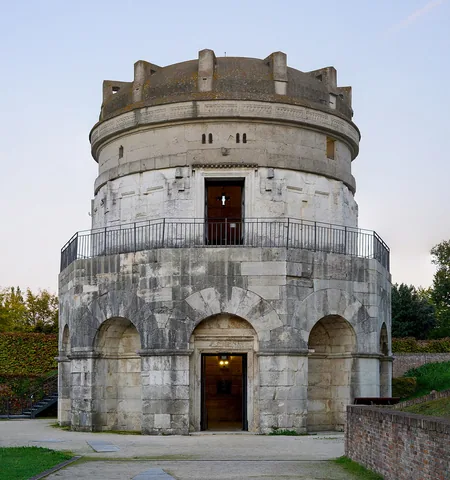
The baptistery's exterior does not reveal its full original height. Ravenna's ground has subsided, and the municipal account describes the original level as roughly three metres lower than the surrounding surface today.
That is a useful caution when you judge an ancient building by how it meets the pavement. A low doorway or a compressed-looking wall may result from changes around the structure, rather than the first builder's intention.
Inside, different materials organise the wall upwards: marble, stucco and mosaic. Let that sequence guide your eye. The octagonal form provides a compact enclosure, and the decoration draws attention towards the dome rather than along a nave. This is a room made for a particular ceremony, with a very different arrangement from a congregational basilica.
Follow the circles towards the baptism
The central image shows Christ in the River Jordan with John the Baptist. A personification of the river also appears. The water is represented as transparent, allowing the body to remain visible beneath its surface.
Around this centre, apostles form a circular procession. Farther out, the design includes plants, altars and empty thrones. You can read the bands as a way of gathering several kinds of sacred imagery around one event.
The geometry is useful even before you identify every figure. The baptism occupies the visual centre; the surrounding images frame it. When looking up becomes uncomfortable, return to the basin at floor level. That movement between image and object recovers the room's purpose more clearly than a list of decorative motifs.
An old ceremony, a surviving object
The font combines Greek marble and porphyry. It was rebuilt in the sixth century and retains older fragments. Even this apparently single object therefore contains more than one moment of work.
That detail changes the way to understand preservation here. A surviving early Christian monument does not need every piece to be untouched in order to carry evidence of its use. The room, its basin and the image of baptism still relate to one another. Keep that relationship in view, and the baptistery becomes an intelligible place of ritual rather than just another decorated ceiling to photograph.