A church that outlived its first court
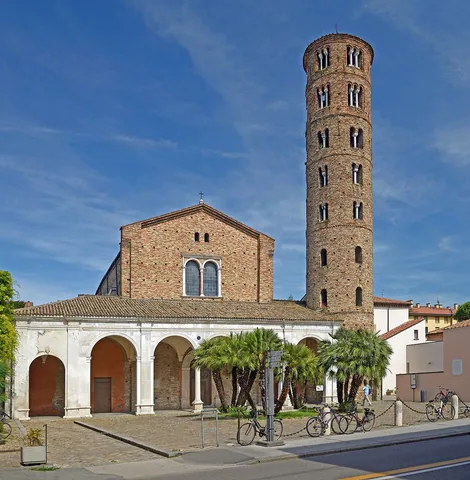
Sant'Apollinare Nuovo stands on Via di Roma in Ravenna. It is the central-city basilica, not the separate church of Sant'Apollinare in Classe outside the city. Its story begins with the Ostrogothic king Theodoric, who built a palace church here around the turn of the sixth century.
The building continued in use after Byzantine conquest and a change in religious allegiance. Its mosaics therefore belong to a space that later authorities could adapt. The long nave helps you read this history: rows of figures move towards sacred subjects, while images of a palace and the harbour city of Classe connect the religious scene to a recognisable world. Begin with that long view, then ask which parts of the decoration represent people, places or ceremonial order.
Use the length of the nave
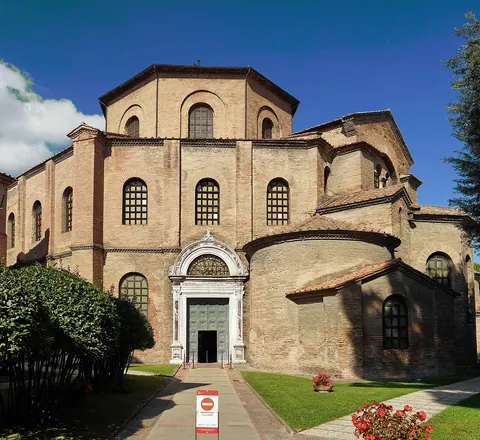
Unlike San Vitale's central octagon, this church stretches your view along a nave. The rows of columns below and the mosaic bands above establish a repeated rhythm. If you have access to the interior, look along a wall before concentrating on a single scene.
The processions create direction. A series of people, rather than one large isolated figure, encourages your eye to move across the surface. Their repeated stance and formal setting make this different from a crowd painted in an everyday street.
The upper scenes include episodes from the life of Christ. Several levels of imagery share the same architectural space. You can separate them visually without attempting to decode the entire programme on a first visit.
Notice the places within the pictures
The mosaics include a representation of Classe, Ravenna's harbour settlement, with walls, buildings and ships. Another section presents Theodoric's palace. These place-images provide a useful pause among the human figures.
Look at the difference between a building and the procession beside it. The architecture suggests a location, while the gold background and carefully arranged figures establish a religious setting. The combination allows a recognisable place to participate in a sacred picture.
The municipal account also notes traces of hands on palace columns where court figures were removed in the Byzantine period. Those fragments matter because alteration can survive inside an apparently complete decorative surface. A mosaic can preserve evidence of subtraction as well as the images someone chose to keep.
Names record changes too
The church's changing dedications are another record of its history. Originally dedicated to the Saviour under Theodoric, it became associated with Saint Martin after conversion to Catholic use. The later dedication to Apollinaris explains the name used today.
The exterior also contains different centuries. The cylindrical bell tower is later than the original church, and the present portico belongs to the sixteenth century. You do not have to treat every visible element as part of Theodoric's commission. The building survived because successive communities kept using and adapting it. Its name, fabric and mosaics preserve different parts of that process.