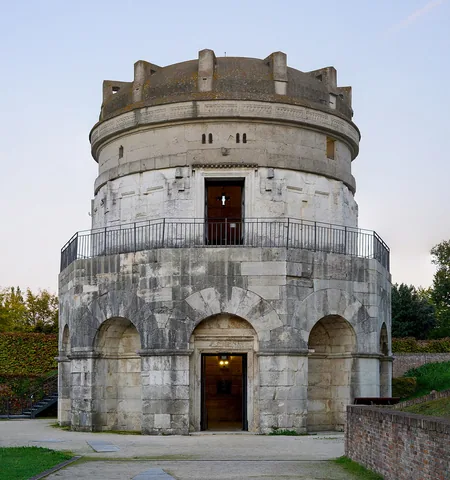
A name that needs an explanation
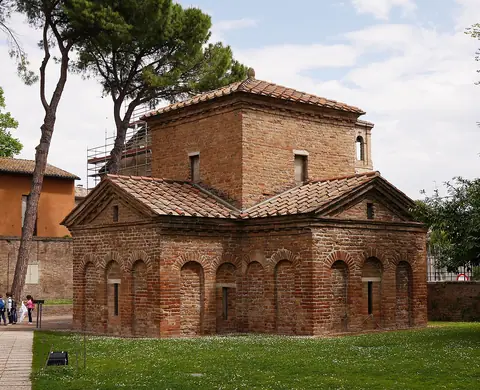
The Mausoleum of Galla Placidia is a small fifth-century building behind San Vitale in Ravenna. Its familiar name suggests a straightforward story: an empress built a tomb and rests inside it. The documented ending is different. Galla Placidia died in Rome in 450 and was buried there.
That correction makes the building more interesting to look at. Its brick exterior encloses a Christian image of life beyond death, expressed through a starry ceiling, a cross and scenes including the Good Shepherd. The sarcophagi and the name belong to the monument's history, but they do not prove the identity of an occupant. If you can visit the interior, begin by comparing the small physical room with the much larger world its decoration suggests.
A small part of a larger complex
Galla Placidia was an imperial patron, the daughter of Theodosius and mother of Valentinian III. The building associated with her originally connected to the church of Santa Croce. It was not conceived as an isolated object in the modern space around it.
The exterior's short crossing arms form a cross-shaped plan. Above their meeting point, the outer square structure conceals the dome. Compare that enclosing brickwork with the interior ceiling in a photograph or during a visit. A roof that looks compact from outside can present a very different shape from within.
Changes in ground level also complicate the present view. The municipal account notes that subsidence has reduced the building's apparent height. What you see is a surviving structure within a changing city, not its original setting held still.
Read the ceiling from its centre
The cross at the centre of the blue, star-filled dome gives you a starting point. Around it, figures and decorative patterns extend across the vaults and lunettes. Rather than trying to count every star, follow how the decoration carries your attention over the edges of the small room.
The Good Shepherd appears with sheep above the entrance. Elsewhere, drinking animals and water form part of the Christian imagery. The individual scenes connect care, salvation and the hope of eternal life.
This is a useful way to understand the contrast between the exterior and interior. The outside establishes a modest enclosure. Inside, the imagery changes the visitor's sense of what that enclosure can contain. That reading does not require you to accept the religious claims; it helps explain the choices made by the patrons and mosaic workers.
Look at the coffins without inventing their owners
Three marble sarcophagi occupy the arms of the building. Their presence is easy to turn into a complete family story, especially when the monument already carries an empress's name. Resist assigning occupants from appearances alone.
Instead, compare the stone chests with the images above them. Burial objects occupy the floor while the decoration directs attention towards the cross and a promised life beyond death. That relationship remains legible even when personal identifications are uncertain. Leave with both parts of the story: a building associated with a powerful fifth-century woman, and a surviving religious interior whose meaning is wider than one burial.