A church built around a centre
San Vitale makes more sense if you first forget the usual picture of a church: a long aisle leading straight towards an altar. This sixth-century basilica in Ravenna gathers its main space around an octagon. A surrounding passage and an upper gallery add layers around that centre. Even the approach to the sanctuary has to be understood within this larger arrangement.
The building began under Ostrogothic rule and reached completion under Byzantine rule. That change of government matters when you reach the mosaics. The sanctuary places Christian worship beside images of imperial authority. Read the shape of the room first, then the figures. You will see how a building can draw attention towards its sacred centre while placing rulers within its religious order.
Follow the building before the gold
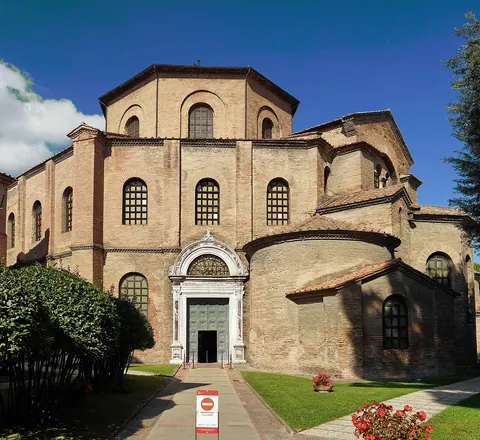
From outside, compare the stepped brick masses. The upper octagon rises above a lower surrounding body. Their relationship helps explain why the interior does not behave like one simple box.
If you enter, allow your eye to follow an opening into the space beyond it, then notice the level above. The surrounding architecture gives several partial views of the central volume. You do not need to identify every column or capital to understand that effect. The building asks you to look across as well as forwards.
Ravenna's municipal account records that the banker Giuliano Argentario financed the work. San Vitale therefore also introduces the people and resources behind monumental building. A sacred dedication alone did not pay for marble, skilled labour and construction.
Who belongs beside the altar?
The mosaics near the sanctuary include the emperor Justinian and the empress Theodora with their attendants. These are images of ceremonial presence. Their ordered groups connect courtly display with the setting of Christian worship.
Compare a human figure with the gold behind it. Clothing, faces and carried objects offer particular details, but the background does not invite you into an ordinary street or landscape. The figures occupy a different visual setting. That helps explain why these panels feel more formal than a scene of people casually gathering.
You can read this as a claim about authority: the empire presents itself within the sacred life of the church. It is an interpretation of the composition, not evidence that the imperial court assembled in this room for the artist.
Let the different centuries remain visible
A richly decorated church can encourage the assumption that everything belongs to the same moment. San Vitale rewards a more careful look. The central vault's painting is eighteenth-century work, while the celebrated sanctuary mosaics belong to the sixth-century church.
That difference does not spoil the building. It gives you a way to separate successive choices. Compare painted surfaces with mosaic surfaces, and the central roof with the sanctuary beyond. Then look back towards the larger octagonal room. The mosaics are easier to understand once they belong to a building, rather than floating as isolated pictures in a history book.