The uneven arch is a clue
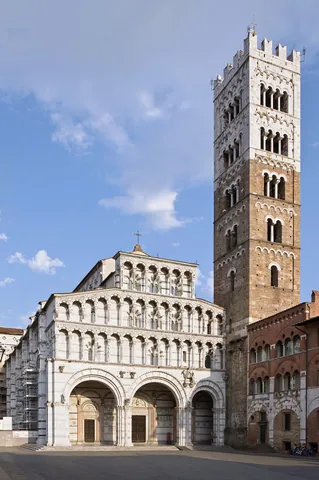
Lucca's cathedral stands in Piazza San Martino, towards the southern side of the historic centre. Its front offers an immediate detail to compare: the three large portico arches are not equal. The smaller one fits beside a bell tower that was already there.
That practical adjustment is a good introduction to a cathedral built and changed over time. Look closer and the portico also contains carved religious stories and a labyrinth. Inside, the Holy Face, or Volto Santo, is a large wooden crucifix that drew medieval pilgrims to Lucca. The facade, the sheltered trading space and the revered image belong to the same wider story: a church serving its city while welcoming people travelling towards Rome.
Pilgrims needed more than an image
The Via Francigena passed through Lucca, and the cathedral's portico had moneychangers' stalls. A visitor might need local currency as well as a place for devotion. An inscription warning against dishonest exchange made that commercial activity a matter of public concern.
Near the bell tower, a small labyrinth is carved into a pillar. Its place beside the portico is easy to miss if you only photograph the whole facade. The winding form has often been discussed in relation to pilgrimage, although its exact intended meaning is not securely settled.
Look at the difference in scale between that modest carving and the layers of columns above. The cathedral addresses a distant viewer through its front, but it also contains details meant to be encountered close up.
The Holy Face has a material history
The Volto Santo shows Christ clothed in a long tunic, with his head projecting forwards and his arms extended. The cathedral museum describes the proportions as suited to a view from below. This is a monumental wooden image rather than a small devotional object.
A legend attributes its making to Nicodemus and describes a miraculous arrival in Italy. That tradition explains the reverence surrounding it; it is not a scientific account of the sculpture's origin.
Radiocarbon research gives a different kind of evidence. The museum dates the surviving wood to the late eighth or ninth century, earlier than scholars had previously thought. The devotional story and the laboratory finding answer different questions. Keep them separate, and you can understand the object's antiquity without presenting a miracle as a verified event.
A memorial with a very different purpose
The cathedral also holds Jacopo della Quercia's early fifteenth-century monument to Ilaria del Carretto, wife of Paolo Guinigi. Her reclining figure lies with a small dog at her feet.
Compare the aim of this memorial with the Volto Santo. One preserves a noblewoman's image in death; the other presents a religious figure for veneration. They share a cathedral without becoming the same kind of object.
If interior access is available, choose a few details and give them time. The guide does not include admission or guarantee that each work is visible during your visit. The facade's unequal arches and small labyrinth already offer a useful starting point outside.