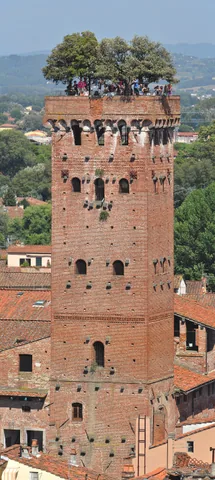
A picture above the square
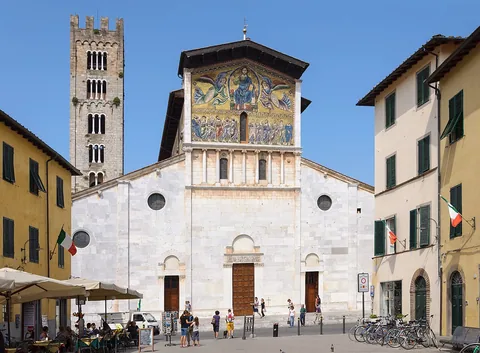
San Frediano announces itself with a large mosaic high on its facade. The subject is the Ascension of Christ. Before you identify every figure, notice the decision to put such a substantial religious image outside, where it addresses people in the square.
The basilica's foundation is associated with Frediano, a sixth-century bishop of Lucca. The building standing here includes major later changes, particularly medieval rebuilding that altered its orientation. Inside are reused columns, a carved baptismal font and chapels connected with local devotion. The facade provides a broad public statement; the interior allows a closer view of how different people and periods added their own images and memorials.
A church that changed direction
The basilica's own historical itinerary explains that medieval work reversed the apse and gave the church its present arrangement. The change responded to the city's expansion. The facade is therefore part of a building whose relationship with the streets evolved.
The columns offer another form of reuse. If you can enter, compare their shafts and capitals rather than assuming an entire row was made as one matching set. The church incorporates older material alongside medieval work.
Such differences can be useful evidence. A building may look unified from the entrance while the smaller parts record a more complicated construction history. You do not have to date each piece to notice that continuity depended on adapting what was available.
The font brings a story within reach
The twelfth-century baptismal font gives sculpture a more intimate scale than the high facade mosaic. Carved scenes wrap around its stone surfaces. The basilica's itinerary identifies several sculptors, including a master who signed part of the basin as Roberto.
A signature helps recover an individual within a large church project. It also reminds you that medieval decoration involved specialised labour. The font's purpose was practical and religious: it held a central place in baptism while presenting stories in stone.
Compare it with the mosaic outside. One image can be seen from across a square; the other asks for close attention around an object. Different distances and materials change the way a story reaches its audience.
Leave room for devotion
Saint Zita, remembered as a servant associated with the Fatinelli household, has a chapel here. Her story carries accounts of charity and miracles, and the church preserves her remains. The miraculous episodes belong to religious tradition and should be described as such.
Her presence adds another scale to the basilica's history. Alongside bishops, patrons and artists stands a figure remembered through domestic work and charitable giving. The different associations help explain why a church can matter to a city beyond its architecture.
San Frediano remains a place of worship. If visiting the interior, follow the church's directions and give people using the chapels space. A useful visit does not require climbing its tower or treating every devotional object as an exhibit.