A park with the body of a fortress
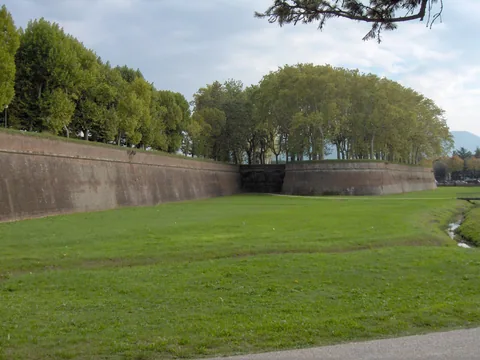
Lucca's walls are easiest to misunderstand from the top. The tree-lined promenade feels like a park, but its width belongs to a system designed for artillery warfare. A brick outer face encloses a great mass of earth. Projecting bastions allowed defenders to cover the adjoining stretches of wall.
This surviving circuit was built mainly in the sixteenth and seventeenth centuries and runs for about 4.2 kilometres around the historic centre. Its later conversion into a public walkway gave it another life. To understand both uses, compare the broad upper level with the steep face seen from outside. The same structure that once separated the city from a possible attacker now gives people a way to move around and look across it.
Why the bastions project
A smooth circle can enclose a town, but a defensive wall also needs to deal with someone approaching its base. Lucca's projecting bastions let defenders look along neighbouring wall faces. Their positions matter as much as their individual shapes.
The Museo Galileo account explains that the ramparts were arranged with adjoining positions in view. Rather than remembering an engineer's name, try to recognise that relationship. Where a section projects outwards, consider the view it opens along the wall beside it.
The thickness matters too. This is not simply an enlarged medieval curtain wall. The accumulated earth and defensive spaces responded to a period when cannon could damage a tall, relatively thin masonry barrier. Lucca invested in a different scale of resistance.
An expensive defence that did not face a siege
The Republic of Lucca authorised a new fortification programme in 1504. Its position beside expanding Tuscan powers made defence a serious civic concern. Construction and improvement involved generations of work.
Yet the Renaissance walls were never used in warfare, according to the museum's historical account. That does not make their builders' intentions imaginary. A fortification could be valuable as a deterrent, and its existence required resources whether a siege happened or not.
Look at the scale of the circuit with that in mind. A traveller can walk past it quickly; the city had to build and maintain the entire thing. Bricks, earth, gates and artillery belonged to a sustained public commitment, rather than one decorative commission.
The promenade changes the view
In the nineteenth century, Maria Luisa of Bourbon commissioned work to arrange the walls as a public walkway. The upper circuit gradually acquired a use that now feels inseparable from the city.
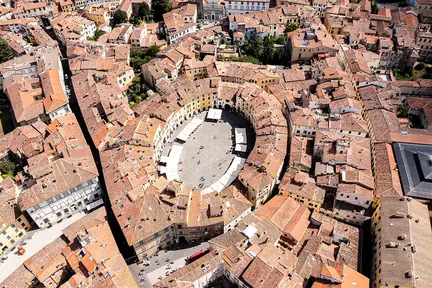
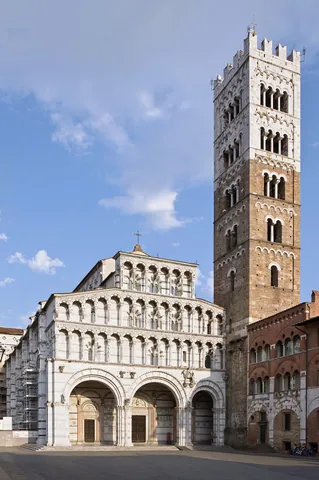
From a safe public section, compare the two sides. Roofs, church towers and gardens lie within; the exterior face and open ground explain the earlier defensive boundary. You do not need to complete the whole circuit to understand that contrast.
The important change was in who used this space and why. A position prepared for guards and weapons became a place for ordinary movement and recreation. The broad earthwork made that change possible. Keep both uses in mind and the promenade's unusual width stops feeling accidental.